
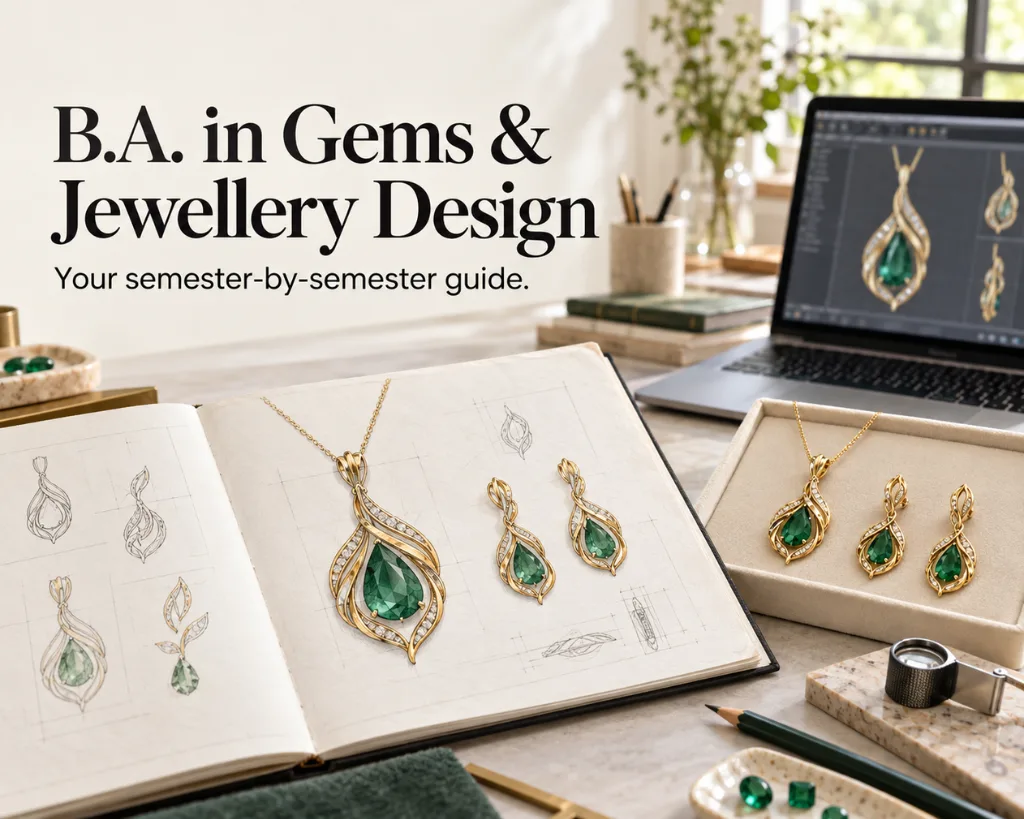
Course pages list modules. They rarely tell you what a term actually feels like, or why the subjects arrive in the order they do. This is an indicative walk through the three years of the B.A. in Gems & Jewellery Design at IIGJ: what you study, roughly when, and what each stage is for. Confirm the detailed BA gems and jewellery design syllabus and credit structure against the official course page before you apply, since curricula are revised periodically.
The logic of the three years is straightforward. You learn to envision, then you learn to make, then you learn to sell. Design comes first, technique second and commerce third, and the final collection asks you to use all three at once.
Semester 1: Learning to Envision
The first term is almost entirely foundation, and it surprises students who expected to start designing jewellery in week one. Observational drawing, line and form, light and shade, colour theory, and the principles of composition. Alongside it comes an introduction to the industry itself, covering how the Indian gems and jewellery trade is structured, who the players are and where the jobs sit, plus jewellery history and ornament traditions.
Materials studies begin here too: metals and their properties, karat and alloys, and the basic vocabulary of gemstones. Nothing you make this term will look like jewellery. The point is to rebuild how you look at objects.
Semester 2: technical precision and the first real pieces
Drawing turns into jewellery rendering, which means representing metal, faceted stones, pearls and surface finishes convincingly on paper, in the conventions the trade actually uses. Technical drawing arrives, bringing orthographic views, dimensions and specifications a manufacturer can work from, which is a different skill from illustration.
The workshop opens. First bench exercises: sawing, filing, annealing, soldering, forming. Most students find this term the turning point, because the metal argues back. Alongside bench work, 3D digital modelling in Rhino introduces computer-aided precision for rapid prototyping and casting. Guided by cultural research, students take on a costume jewellery project while building essential commercial skills, from pricing and business basics to professional product photography for portfolio development. Gemstone studies deepen through the classification of coloured stones and the framework covered in the 5Cs of coloured gemstones and the 15 cuts and shapes of coloured gemstones.
Semester 3: CAD, Manufacturing and the business of design
Among the BA jewellery design subjects, this is where employability starts to build. CAD progresses with Matrix or MatrixGold, not as software training but as design-for-manufacture: wall thickness, prong geometry, stone seats and clearance for a setter’s tools. Rendering for client presentation follows.
Design thinking widens at the same time. Students learn to analyse design philosophies across global and Indian hubs, building cross-cultural design versatility and aligning creative decisions with strict budget constraints and target retail pricing.
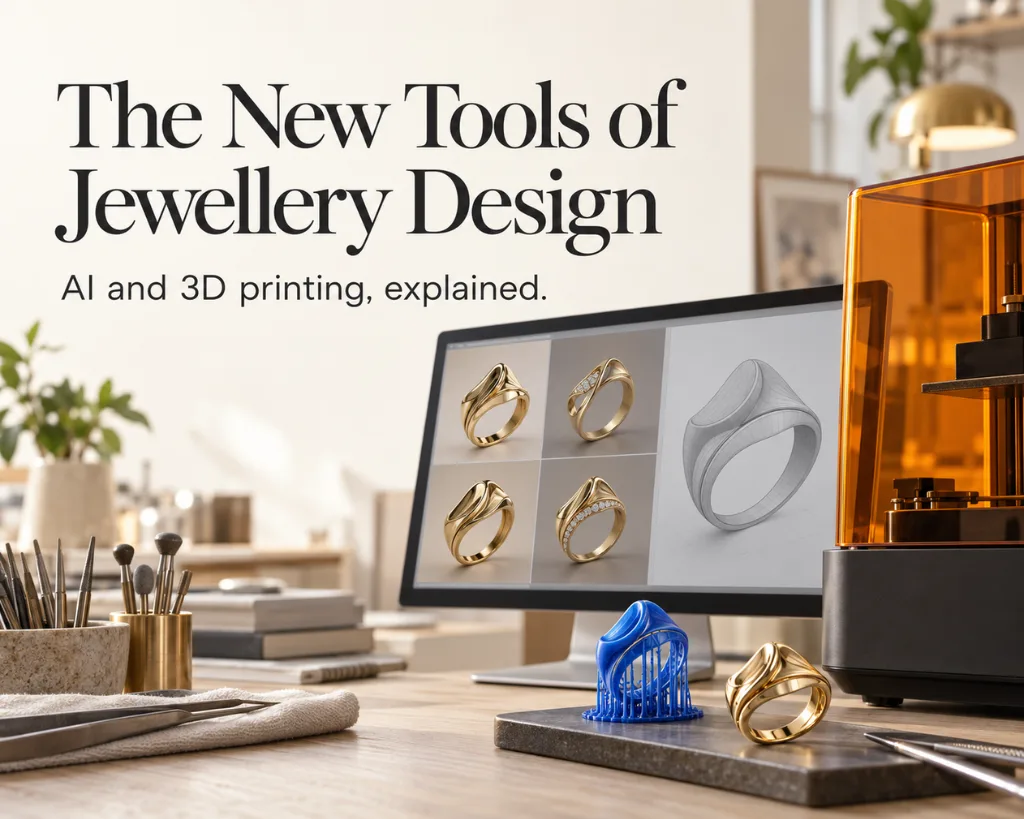
Manufacturing technology runs alongside, covering 3D printing and wax patterns, investment casting, finishing processes, and what each one demands of a design. Students who have watched a thin-walled model come out of a flask porous design differently afterwards. The full sequence is described in inside the bench.
This semester also introduces trend analysis, collection planning and retail structures across Indian and global markets. Students are guided from problem identification and prototyping to crafting business plans and elevator pitches, while the programme builds essential financial discipline by covering product costing, cash flow and P&L statements.
Diamond studies begin: the 4Cs, grading practice with real stones, and the measurement conventions covered in know your diamond’s weight, measurement and size.
Semester 4: Gemmology, Setting, Costing and the Capstone
Gemmology becomes technical. Gem identification with instruments, including the refractometer, polariscope, spectroscope, microscope and 10x loupe, plus treatments, synthetics and the separation of lab-grown from natural material, which is now core rather than specialist knowledge. Reading and interpreting laboratory reports is part of this.
At the bench, stone setting: prong, bezel, pavé, channel and flush, executed by hand. And then the module students remember longest, which is costing. Metal weight against rate, stone cost, making charges, wastage, and what happens to a design’s price when you change its karat or add two millimetres. This is usually the term in which students stop designing impossible things.
In parallel, design trends and forecasting help students align concepts with market direction, while retail merchandising and e-commerce introduce digital storefronts and sales channels. All of this learning is applied in Stage I of the Capstone Design Project, developing a theme-based five-piece collection. Specialised electives in either diamond valuation or quality control round out the semester with sharp, industry-focused expertise.
Semester 5: merchandising, luxury and international trade
The jewellery design degree curriculum turns commercial. Merchandising and product development: how collections are planned, how ranges are built to a price architecture, and how buyers actually make decisions. Luxury design codes, consumer segmentation and ergonomic wearability take centre stage, alongside commercial diamond grading and ethical trade practices.
EXIM policies and customs procedures prepare students for international trade, while bench skills expand into alternative materials and tension setting. Electives in visual merchandising or digital marketing refine retail presentation and online campaigns. The term culminates in the Design Project for the collection, where high-jewellery concepts move from CAD/CAM prototyping to complete showcase execution.
Semester 6: the graduating exhibition and the internship
The final semester opens with the exhibition. The themed collection developed across Semesters 4 and 5, from concept and research through sketching, CAD, costing and manufacture to finished pieces, is shown at IIGJ’s annual GLIMPZ showcase and at industry platforms, which is how a good many students are first seen by employers. You defend your concept, justify your costing, and present work that has to survive being handled.
The industry internship follows, with a manufacturer, exporter, designer or retailer. It is the single most useful term of the degree, because it tells you which of the industry’s many roles you actually want, and it is where a good number of placement conversations begin. Placements has the picture from the other side.
Alongside it, portfolio development and professional practice cover pricing your work, presenting to clients, and the beginnings of the operational knowledge that matters if you intend to start your own label, which we set out in starting your own jewellery label.
What the three years are really Building
By the end you should be able to take a brief, research it, design to a price, model it for manufacture, specify its stones, cost it accurately, see it through the bench to a finished piece, and explain every decision along the way. That combination, rather than any single subject, is what the degree is for, and it is why graduates go into design, CAD, merchandising, product development, grading and their own businesses rather than only into one.
Eligibility is 10+2 from any recognised board in any stream, and the programme runs at the Mumbai institute. If you are weighing this against a shorter route, diploma, degree or certificate compares them directly, and jewellery design courses after 12th maps all the entry points. For intake dates and the current syllabus, speak to admissions.