



The Business of Jewellery: Understanding Retail, Pricing and Consumer Trends
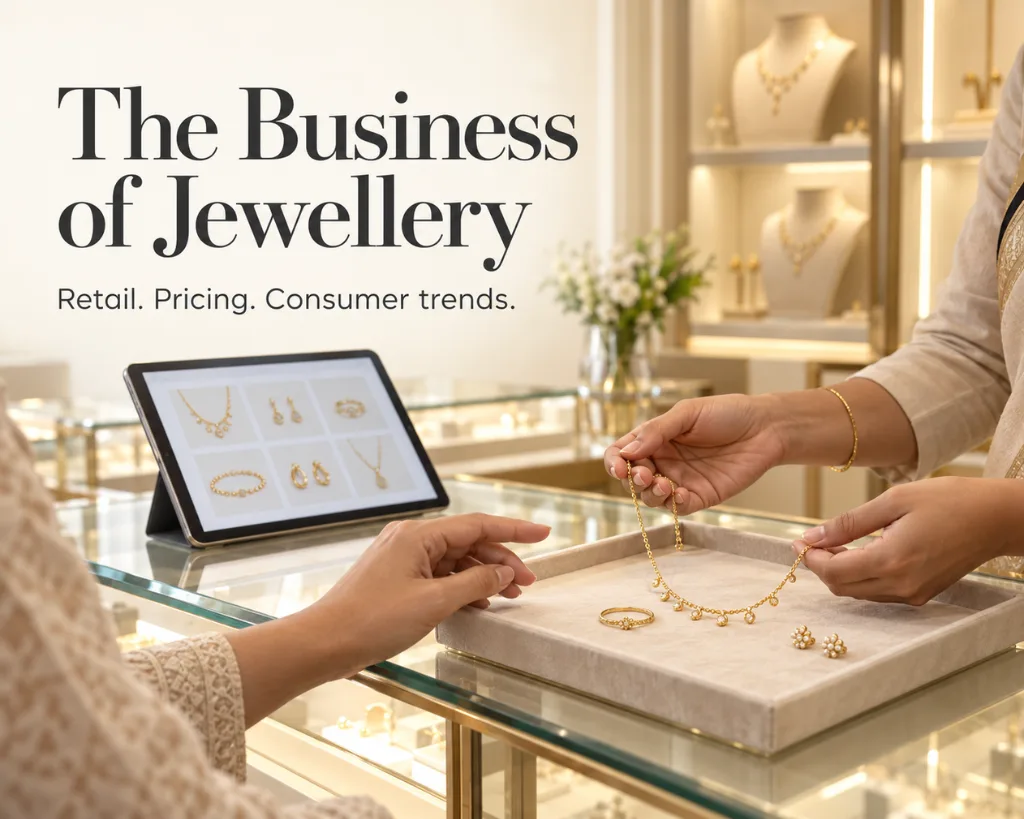
Jewellery is no longer sold only across counters. It is sold through trust, storytelling, store experience, pricing transparency, digital discovery and consumer psychology. India’s gem and jewellery sector is a USD 100 billion industry, and the business of jewellery is no longer just about gold weight and craftsmanship. It is about how stores are designed, how prices are built, how brands communicate value and how buyers now decide. For anyone entering this space, understanding these forces is the difference between selling a product and building a jewellery business. Retail: From Family Showrooms to Omnichannel Storefronts Indian jewellery retail has moved through several stages over the last two decades. The market now includes independent family jewellers, branded national chains and omnichannel players who sell across stores, websites, marketplaces and Instagram. Each format serves a different buyer. Local jewellers thrive on trust, relationships and customisation. National chains win on certification, design libraries, exchange policies and a consistent retail experience. Digital-first brands capture younger buyers who research online before visiting a store or making a purchase decision. The modern jewellery retailer can no longer depend on a single channel. One customer may discover a design on Instagram, compare prices online, visit a showroom, speak to family and only then make the final purchase. Retail now depends on how well a brand connects every touchpoint. Pricing: Where Gold Ends and Brand Begins Jewellery pricing is one of the most misunderstood parts of the industry. The final tag is not just gold value. It is a combination of several cost and value layers. The trend today is not only that jewellery has multiple price components. The larger shift is that buyers want more clarity around them. They want to understand what they are paying for, why making charges differ, how stone quality affects price, and why two similar pieces can carry different final tags. Two retailers can sell the same 22-karat necklace at very different prices because making charges, wastage percentages, craftsmanship and brand positioning all change the calculation. Buyers who understand this stack make more informed decisions. Retailers who explain it clearly build trust faster. Consumer Trends: The Shift from Heirloom to Everyday The modern jewellery consumer is not buying the way previous generations did. Pieces once bought mainly for weddings, inheritance or long-term family value are now joined by jewellery meant for everyday wear, self-expression, gifting, workwear and personal milestones. Five shifts are redrawing the market: The result is a market where design sensibility, transparent pricing and a strong online story matter as much as the showroom itself. For jewellery businesses, the sale often begins long before the customer enters the store. Why This Matters for the Next Generation The business of jewellery rewards people who can think across craft, commerce and consumer behaviour. Designers need to understand price points. Retail managers need to read trends. Merchandisers need to know both the gold rate and the Instagram feed. That is exactly the kind of industry-ready training IIGJ delivers across its institutes in Mumbai, Delhi, Jaipur, Varanasi, Udupi, Guwahati and Ratnagiri, through programmes in jewellery management, merchandising, design and luxury brand management. Graduates go on to roles in retail, merchandising, product development and brand management, and placements shows where they have gone. For the next generation of jewellery professionals, technical skill alone is not enough. The industry needs people who understand the product, the price, the platform and the person buying it. That is what turns jewellery from an object of value into a business of trust, design and experience. To see which programme fits you, speak to admissions about the current intake.
How Technology Is Transforming Jewellery Design: AI and 3D Printing Explained
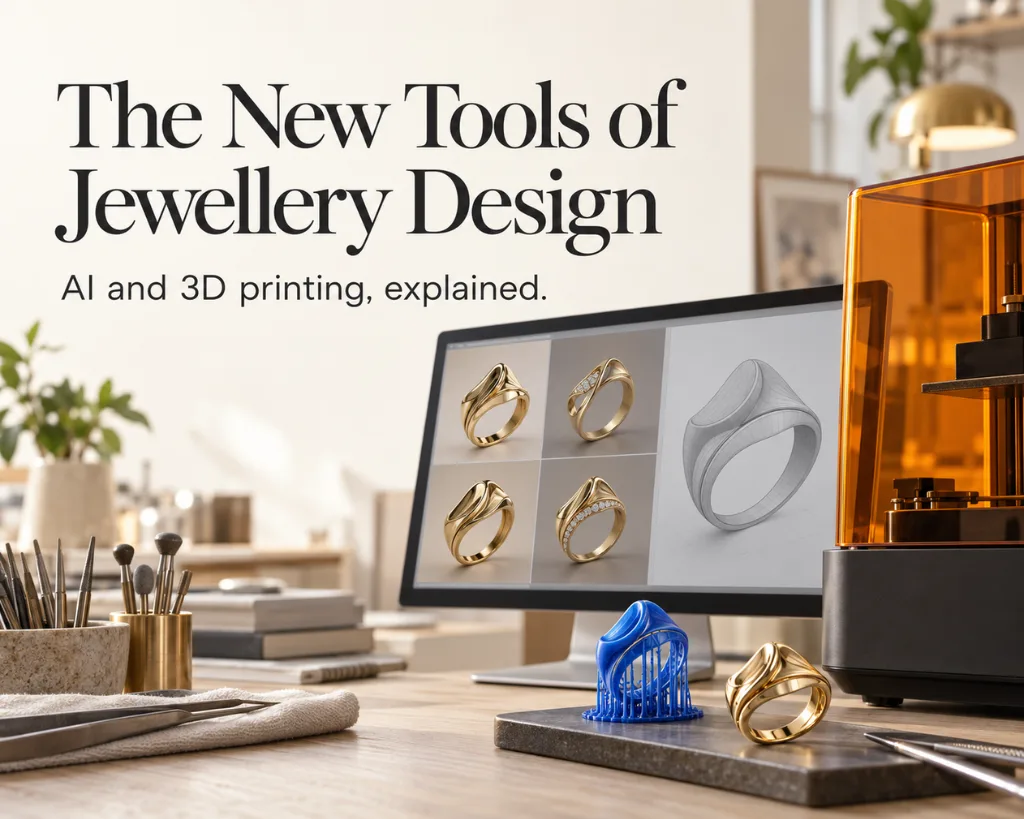
Jewellery design has always balanced imagination with technique. A sketch, a gemstone, a metal setting, a motif and a maker’s hand all come together to create something meaningful. Today, that process is being shaped by a new set of tools. AI and 3D printing are changing how jewellery ideas are explored, refined, tested and produced. Before a single gram of gold is melted, many design decisions now begin on a screen, through CAD, AI-assisted design, digital modelling and rapid prototyping. This shift matters especially in India, where gems and jewellery remain one of the country’s most significant industries. According to IBEF data citing GJEPC, the Indian gem and jewellery market was valued at USD 85 billion and is projected to reach USD 130 billion by 2030. For students considering a career in jewellery design, this means one thing clearly: technology is no longer separate from the craft. It is becoming part of how modern jewellery is imagined, developed and brought to life. AI Tools: Designing Smarter, Not Just Faster AI in jewellery design is not about replacing creative judgement. It is about helping designers work more intelligently, especially during research, ideation and variation development. Trend-forecasting tools, for example, study purchase patterns, social media behaviour and retail movement to understand which styles, motifs, colours and forms may become popular in the coming months. This helps designers create collections that are not only beautiful but also relevant to the market they are designing for. Generative design tools can also create multiple design directions from a single brief. A student or designer working on a ring, pendant, bracelet or bridal concept can explore different structures, patterns, proportions and settings far more quickly. The final decision still depends on the designer’s eye, understanding of wearability, material knowledge and sense of aesthetics. This is where AI earns its place. It gives designers more options to study, compare and refine, but it does not replace the human ability to understand the emotion, culture, craftsmanship and purpose behind a piece of jewellery. At IIGJ Jaipur, AI-powered design is taught alongside manual sketching and CAD in the PG Diploma in Jewellery Design, Technology and Management. 3D Printing: From Screen to Studio 3D printing has become one of the most important links between digital design and physical jewellery making. Once a design is created in CAD software such as Rhino or Matrix, it can be converted into a physical model through 3D printing. This allows designers, manufacturers and clients to see the form, size, proportion and detailing of a piece before it is cast in metal. Stereolithography, commonly known as SLA, is one of the 3D printing methods used in jewellery. In simple terms, SLA uses light to build highly detailed resin or wax-like models layer by layer. These models then go into the lost-wax casting process, which has been used in fine jewellery manufacturing for generations. Modern technology, in other words, is not replacing traditional jewellery-making methods. It is making the process faster, more accurate and easier to refine. A design that might need several manual trials can now be tested, corrected and approved with far greater precision before it reaches production. Prototyping accounted for 43.4% of the global 3D printed jewellery market in 2024, according to Data Bridge Market Research. That figure shows how deeply 3D printing has entered the jewellery workflow, especially for testing and refining designs before manufacturing. Where Traditional Craft and Modern Technology Meet The future of jewellery design does not belong only to technology, and it does not belong only to traditional craft. It belongs to professionals who understand both. A jewellery designer today needs to think creatively, sketch ideas, understand gemstones, study forms, work with metals and respect the techniques that have shaped the industry for generations. They must also be comfortable with CAD, digital rendering, AI-assisted ideation and 3D printing. The strongest designers can move from a design screen to a workbench without losing the essence of the piece. This combination is especially important in India, where jewellery carries cultural, emotional and ceremonial value. Technology improves speed and precision, but the meaning behind a mangalsutra, a bridal set, an heirloom, a temple jewellery piece or a contemporary luxury design still needs human understanding. How IIGJ Prepares Students for This Shift At IIGJ, students learn jewellery design as a balance of creativity, craftsmanship, technical knowledge and industry readiness. AI-assisted design, CAD, 3D printing, gemmology, jewellery manufacturing and traditional goldsmithing are treated as connected parts of the same learning journey. That journey can begin at different points. The B.A. in Gems & Jewellery Design and the B.Des in Jewellery Design cover the full spectrum, from hand rendering to CAD and production. The Diploma in Computer Aided Design takes students deep into Rhino and Matrix, while the Diploma in Jewellery Manufacturing builds skill at the bench, in casting and in finishing. For those adding a single capability, the professional certificate in CAD Rhinoceros for Jewellery is a focused place to start. This approach builds the confidence to work across every stage of jewellery creation, from concept development and design visualisation to prototyping and production. As the industry evolves, students who understand both craft and technology will be well prepared for careers in design studios, manufacturing units, jewellery brands, CAD departments, export houses and their own ventures. Placements show where IIGJ graduates have gone, and why the jewellery industry is a brilliant career choice that sets out the bigger picture. Technology is transforming jewellery design, but the designer remains central. The tools may be changing, but the need for imagination, skill, cultural understanding and craftsmanship is stronger than ever. If you are deciding where to begin, see every jewellery design course after 12th, or speak to admissions about the current intake.
10 What a B.A. in Gems & Jewellery Design Actually Covers, Semester by Semester
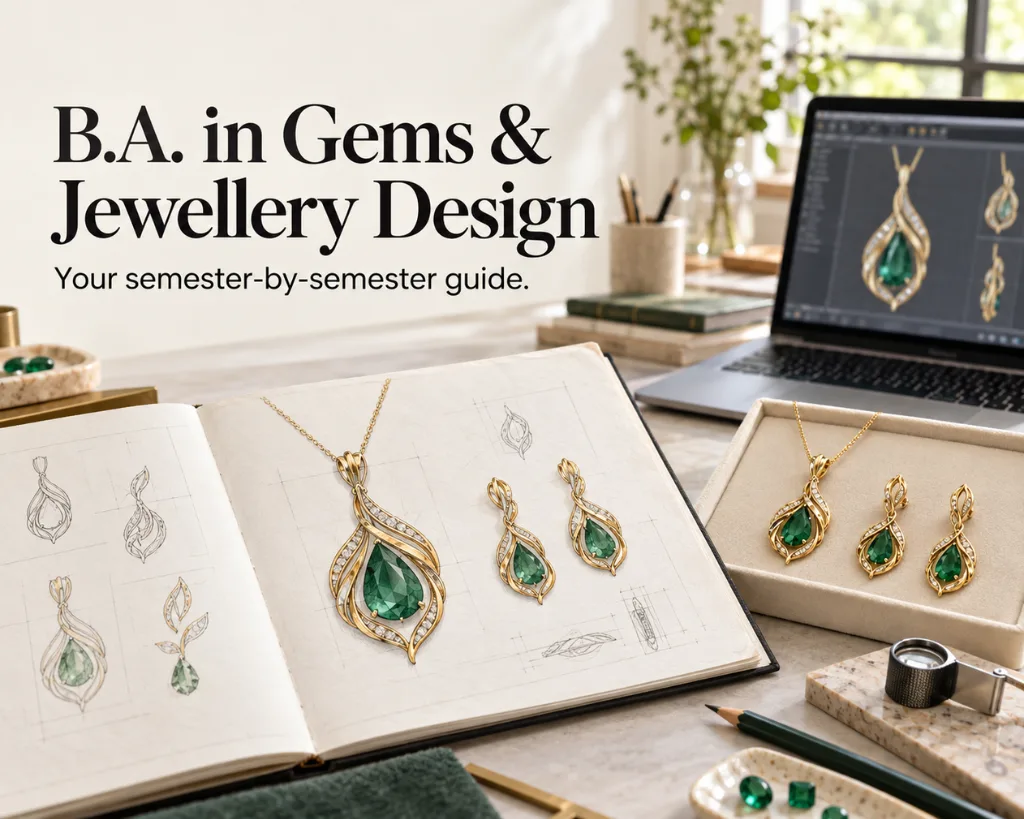
Course pages list modules. They rarely tell you what a term actually feels like, or why the subjects arrive in the order they do. This is an indicative walk through the three years of the B.A. in Gems & Jewellery Design at IIGJ: what you study, roughly when, and what each stage is for. Confirm the detailed BA gems and jewellery design syllabus and credit structure against the official course page before you apply, since curricula are revised periodically. The logic of the three years is straightforward. You learn to envision, then you learn to make, then you learn to sell. Design comes first, technique second and commerce third, and the final collection asks you to use all three at once. Semester 1: Learning to Envision The first term is almost entirely foundation, and it surprises students who expected to start designing jewellery in week one. Observational drawing, line and form, light and shade, colour theory, and the principles of composition. Alongside it comes an introduction to the industry itself, covering how the Indian gems and jewellery trade is structured, who the players are and where the jobs sit, plus jewellery history and ornament traditions. Materials studies begin here too: metals and their properties, karat and alloys, and the basic vocabulary of gemstones. Nothing you make this term will look like jewellery. The point is to rebuild how you look at objects. Semester 2: technical precision and the first real pieces Drawing turns into jewellery rendering, which means representing metal, faceted stones, pearls and surface finishes convincingly on paper, in the conventions the trade actually uses. Technical drawing arrives, bringing orthographic views, dimensions and specifications a manufacturer can work from, which is a different skill from illustration. The workshop opens. First bench exercises: sawing, filing, annealing, soldering, forming. Most students find this term the turning point, because the metal argues back. Alongside bench work, 3D digital modelling in Rhino introduces computer-aided precision for rapid prototyping and casting. Guided by cultural research, students take on a costume jewellery project while building essential commercial skills, from pricing and business basics to professional product photography for portfolio development. Gemstone studies deepen through the classification of coloured stones and the framework covered in the 5Cs of coloured gemstones and the 15 cuts and shapes of coloured gemstones. Semester 3: CAD, Manufacturing and the business of design Among the BA jewellery design subjects, this is where employability starts to build. CAD progresses with Matrix or MatrixGold, not as software training but as design-for-manufacture: wall thickness, prong geometry, stone seats and clearance for a setter’s tools. Rendering for client presentation follows. Design thinking widens at the same time. Students learn to analyse design philosophies across global and Indian hubs, building cross-cultural design versatility and aligning creative decisions with strict budget constraints and target retail pricing. Manufacturing technology runs alongside, covering 3D printing and wax patterns, investment casting, finishing processes, and what each one demands of a design. Students who have watched a thin-walled model come out of a flask porous design differently afterwards. The full sequence is described in inside the bench. This semester also introduces trend analysis, collection planning and retail structures across Indian and global markets. Students are guided from problem identification and prototyping to crafting business plans and elevator pitches, while the programme builds essential financial discipline by covering product costing, cash flow and P&L statements. Diamond studies begin: the 4Cs, grading practice with real stones, and the measurement conventions covered in know your diamond’s weight, measurement and size. Semester 4: Gemmology, Setting, Costing and the Capstone Gemmology becomes technical. Gem identification with instruments, including the refractometer, polariscope, spectroscope, microscope and 10x loupe, plus treatments, synthetics and the separation of lab-grown from natural material, which is now core rather than specialist knowledge. Reading and interpreting laboratory reports is part of this. At the bench, stone setting: prong, bezel, pavé, channel and flush, executed by hand. And then the module students remember longest, which is costing. Metal weight against rate, stone cost, making charges, wastage, and what happens to a design’s price when you change its karat or add two millimetres. This is usually the term in which students stop designing impossible things. In parallel, design trends and forecasting help students align concepts with market direction, while retail merchandising and e-commerce introduce digital storefronts and sales channels. All of this learning is applied in Stage I of the Capstone Design Project, developing a theme-based five-piece collection. Specialised electives in either diamond valuation or quality control round out the semester with sharp, industry-focused expertise. Semester 5: merchandising, luxury and international trade The jewellery design degree curriculum turns commercial. Merchandising and product development: how collections are planned, how ranges are built to a price architecture, and how buyers actually make decisions. Luxury design codes, consumer segmentation and ergonomic wearability take centre stage, alongside commercial diamond grading and ethical trade practices. EXIM policies and customs procedures prepare students for international trade, while bench skills expand into alternative materials and tension setting. Electives in visual merchandising or digital marketing refine retail presentation and online campaigns. The term culminates in the Design Project for the collection, where high-jewellery concepts move from CAD/CAM prototyping to complete showcase execution. Semester 6: the graduating exhibition and the internship The final semester opens with the exhibition. The themed collection developed across Semesters 4 and 5, from concept and research through sketching, CAD, costing and manufacture to finished pieces, is shown at IIGJ’s annual GLIMPZ showcase and at industry platforms, which is how a good many students are first seen by employers. You defend your concept, justify your costing, and present work that has to survive being handled. The industry internship follows, with a manufacturer, exporter, designer or retailer. It is the single most useful term of the degree, because it tells you which of the industry’s many roles you actually want, and it is where a good number of placement conversations begin. Placements has the picture from the other side. Alongside it,
Diploma, Degree or Certificate? Choosing the Right Jewellery Qualification for Where You Are Now

The diploma vs degree in jewellery design question gets asked as though one answer is better. It isn’t. These are three different products solving three different problems, and the right choice depends almost entirely on where you are standing when you ask: how old you are, how much time you have, whether you already work, and whether you are trying to enter the industry or move within it. Here is what actually separates them. What a degree buys you Three to four years, breadth, and a recognised academic qualification. A degree such as the B.A. in Gems & Jewellery Design or the B.Des in Jewellery Design takes you across design, rendering, CAD, manufacturing, gemmology, merchandising and management, with an internship and a graduating collection at the end. What you are really buying is time to become good. Design ability compounds slowly, and three years of studio work, critique and iteration produces a different practitioner from six months of instruction. The portfolio you leave with reflects that. A degree also keeps doors open to postgraduate study, to teaching, and to roles where a graduate qualification is a formal requirement. The cost is exactly that: three years, and the opportunity cost of not earning during them. If you are 18 and coming straight from school, that is usually the right trade. At 30, with a job, it often isn’t. What a diploma buys you Focus and speed. A diploma commits to one part of the trade and goes deep on it, with much less general education around the edges. The Diploma in Jewellery Design, Diploma in Jewellery Manufacturing, Diploma in Gemmology and Diploma in Computer Aided Design each produce someone employable in a defined role rather than broadly educated across the industry. Eligibility is 10+2 from any recognised board, the same as the degrees. The B.Des vs diploma jewellery comparison, put plainly: the B.Des makes you a designer with an academic credential, while the diploma makes you a specialist, faster. Employers in manufacturing and CAD hire diploma holders readily and care far more about what you can do than about the certificate’s name. The limitation is lateral movement. A CAD diploma holder who later wants to run merchandising has a gap to fill. That is solvable, but through further study rather than automatically. What a certificate buys you One skill, quickly, at low risk. The jewellery certificate course value is widely underestimated because people compare it to a degree, which is the wrong comparison. A certificate is not a small degree. It is a tool. It works well in four situations. You want to test whether this industry suits you before committing years. You are joining a family jewellery business and need working knowledge of grading, CAD or merchandising now. You already work in the trade and need one capability added. Or you are a designer in another discipline moving sideways. The professional certificate courses each isolate a skill: CAD in Rhino, diamond grading, gem identification, bench work, metal setting and merchandising. They also stack usefully. CAD plus diamond grading plus merchandising, taken over two or three years while working, is a genuine professional profile. The fourth option people forget If you already hold a degree in something else, whether commerce, engineering, architecture or fashion, the postgraduate route is usually better than starting a second bachelor’s. The Post Graduate Diploma in Jewellery Management is a one-year programme open to graduates from any discipline, covering design, manufacturing, gemmology, CAD, merchandising and management. It is the standard route for career changers and for family-business successors, and its cohorts are deliberately mixed across backgrounds. A straight way to decide • If you have just finished school with three or four years available, take the degree. • If you have just finished school and are certain about one specialism and want to earn sooner, take the diploma in that area. • If you are already a graduate in another field, take the PG Diploma rather than a second bachelor’s. • If you are already working, or running a family business, take certificates and stack them over time. • If you are not sure the industry is for you, take one short certificate and find out. What matters more than the format Two things, consistently. First, how much hands-on time the programme includes: workshop hours, live CAD, real stones in your hand. A qualification earned mostly through lectures produces graduates who struggle in their first job, whatever it is called. Second, your portfolio. Employers in this industry look at work before credentials, and the people who do well are the ones who kept making things throughout. The full range of formats is on the programs page, with the entry-level view in jewellery design courses after 12th and a related perspective in how to choose the right jewellery course. Availability varies by location, so check the campuses page.
Jewellery Design Courses After 12th: Every Route, Who Can Apply, and Where Each One Leads
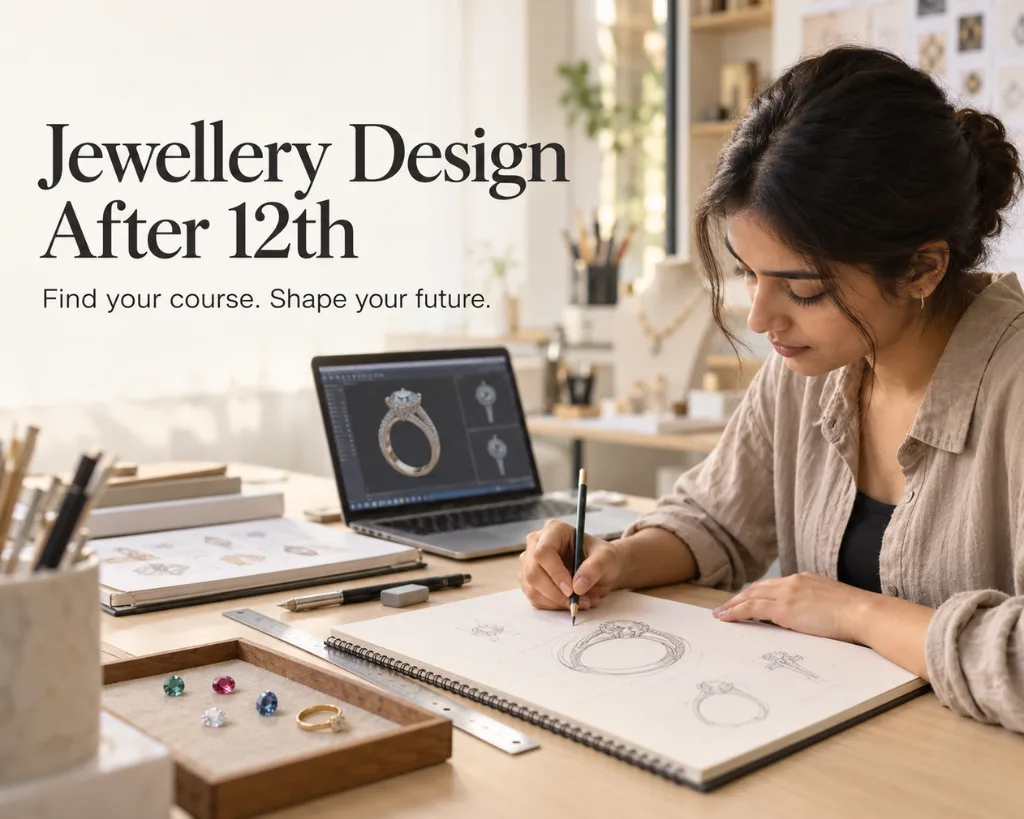
If you have just finished school and jewellery design has caught your interest, the first thing worth knowing is that there is no single route in. There are four, they suit very different people, and the difference between them is not prestige. It is time, depth and what you want to be doing in three years. Here is what a jewellery design course after 12th actually looks like at each level. First, the eligibility question The jewellery design eligibility bar is lower than most students expect. For degree and diploma programmes at IIGJ, you need 10+2 from any recognised central or state board, in any stream. The courses after 12th arts commerce science students take are the same courses. There is no science requirement, no mathematics cut-off and no stream restriction. There is also no national entrance examination for jewellery design of the kind that governs engineering or medicine. Admission is generally by application, with an interaction or interview and, where relevant, a look at whatever creative work you have. Which leads to the question every applicant asks. Do you need to be able to draw? No, not to be admitted. Drawing is taught from the ground up, and every cohort includes students who arrived unable to render a straight line. What is not taught is interest: the willingness to look closely at objects, to redraw something eleven times, and to care about a two-millimetre difference. Students who have that overtake naturally gifted sketchers within a year, consistently. If you do have work, whether sketchbooks, craft projects or anything made by hand, bring it. It helps the conversation. It is not a gate. Route one: A degree This is the fullest route, and the right one if you are coming straight from school with three or four years to give it. A degree covers everything: design fundamentals, hand rendering, CAD, manufacturing, gemmology and diamond grading, merchandising and management, plus an industry internship and a graduating collection. IIGJ runs the B.A. in Gems & Jewellery Design as a three-year programme at Mumbai and the B.Des in Jewellery Design at Jaipur and Delhi, and all of them are university-affiliated degrees. A degree gives you a recognised qualification, the option of postgraduate study later, and, the part students underestimate, three years to actually become good rather than six months to become employable. If you want to see what the three years contain term by term, we have broken it down in what a B.A. in Gems & Jewellery Design actually covers. Route two: A diploma This route is shorter and more focused, and it is the right call if you want to be working sooner or already know which part of the trade you want. Diplomas at IIGJ take 10+2 from any board and specialise from the start: • The Diploma in Jewellery Design covers design principles, trends, materials and CAD-CAM. • The Diploma in Jewellery Manufacturing covers the bench, casting, finishing and production. • The Diploma in Gemmology covers diamonds and coloured stones, grading and identification. • The Diploma in Computer Aided Design covers Rhino and Matrix for jewellery, to a professional standard. • The Master Gemmologist Programme covers gem identification with instruments, for the laboratory and valuation side. A diploma trades breadth for speed. You will be job-ready in a defined role rather than broadly educated across the industry. Route three: A professional certificate These are short, single-skill courses, and they are genuinely useful in three situations. You want to test whether this industry suits you before committing years. You are joining a family jewellery business and need specific knowledge quickly. Or you already work in the trade and need one capability added. The professional certificate courses cover individual skills, including CAD in Rhino, diamond grading, gem identification, bench work, metal setting, merchandising and Navratnas. They also stack: several certificates taken over time build into a real skill profile. Where each one leads Jewellery design is one entry point to an industry with a lot of doors. Graduates work as designers and CAD artists, as merchandisers and product development executives with manufacturers and exporters, as gemmologists and graders in laboratories, as valuers, in retail and store management, in sourcing, and in their own labels. The industry-side view is set out in why the jewellery industry is a brilliant career choice, and placements shows where IIGJ graduates have gone. Choosing, practically If you have three years, take the degree. If you are clear about one specialism and want to work sooner, take the diploma in that area. If you are testing the water, or adding a skill to something you already do, take a certificate. Location matters too, since IIGJ runs Institute in Mumbai, Delhi, Jaipur, Udupi, Guwahati, Varanasi and Ratnagiri, and not every programme runs everywhere, so the institutes page has the details. If you are still weighing formats, diploma, degree or certificate compares them directly, and admissions will tell you what the current intake looks like.
Starting Your Own Jewellery Label: Nine Things Nobody Tells Design Graduates

Most advice on how to start a jewellery business in India is about brand. Find your aesthetic, know your customer, tell your story. All true, and all covered: we have written about it in the business of jewellery: what it takes to build a brand. This piece is about the other half, the half that actually sinks new labels, which is compliance, costing, cash and karigars. Nine things graduates consistently learn the expensive way. 1. Registration and GST come before the first sale, not after Pick a structure, whether proprietorship, LLP or private limited, and register it. Get a PAN and a GST registration, since jewellery falls under HSN Chapter 71. Rates have been stable for some time at 3 per cent on gold jewellery and 5 per cent on job work and making charges, but rates and thresholds change, so confirm the current position with a chartered accountant rather than with a blog. Selling without GST registration while chasing marketplace listings is the commonest early mistake, because no marketplace will onboard you without it. 2. You cannot sell hallmarked gold without a BIS licence The jewellery business licence BIS issues to jewellers is a registration on the BIS portal, and it is what allows you to sell hallmarked gold in notified districts. Without it your pieces cannot be hallmarked in your name, and unhallmarked gold jewellery cannot legally be retailed. Registration is inexpensive and mostly paperwork. The practical work is building a relationship with an assaying and hallmarking centre and understanding what each piece will come back stamped with. Those marks are explained in BIS hallmarking and the six-digit HUID. 3. Learn to cost properly, then add your margin on top A jewellery price is built, not chosen. The components are metal weight multiplied by the day’s rate for that karat, stone cost, a making or labour charge quoted either per gram or as a percentage, a wastage or loss allowance, plating, certification and packaging, and then GST. Two lines cause most of the damage. Wastage is real, since metal is genuinely lost in filing, polishing and casting, but it is also where inflated numbers hide, and a brand that does not track its actual loss is either overcharging customers or quietly funding someone else. And karigar quotes rarely include rejections. Price for the pieces that fail QC, because some will. 4. Your karigar relationship is your production line You will not manufacture in-house at the start. You will work with karigars, and the terms are unfamiliar to anyone who has only studied design: gold issued on weight against a return, metal exchange, loss accounted per job, payment against delivery. Get the weight accounting right from day one, in writing. These relationships run on trust built slowly and destroyed instantly, and a designer who understands the bench earns it faster. That is one practical argument for having filed a casting yourself, as described in inside the bench. 5. Inventory is where your money goes and stays This is the difference between jewellery and almost every other design business. Stock is not a cost of goods sold. It is capital sitting in a safe. Ten designs across three sizes and two metals is sixty pieces before you have sold anything. Launch narrow, with one tight collection and few SKUs or variants, and expand from what actually sells. Made-to-order takes longer and converts less, but it is how most labels survive year one. 6. Photography is not a nice-to-have Jewellery is the hardest product category to photograph and the one most dependent on it. It is small, reflective and detail-dependent. Budget for a proper macro setup, or for a photographer who shoots jewellery specifically, because a generalist will not get it right. Every channel judges you on the first image, and inconsistent product photography reads as an inconsistent brand. 7. Choose a channel deliberately The options to sell jewellery online India offers have different economics, not just different reach. Your own site gives you margin and customer data but no traffic until you buy it. Marketplaces bring volume and take commission that can reach a fifth of the price, with returns on your account. Instagram sells well through direct messages and converts poorly to a cart. Exhibitions and pop-ups produce cash quickly and cost heavily in stall fees and travel. Stockists and multi-brand stores reach the right buyer and pay late. Pick two, learn them properly, and ignore the rest for a year. 8. Write your returns and buyback policy before you need it Customers will ask what happens if they exchange a piece, what your buyback rate is, and whether making charges are refundable. Decide these in advance, publish them, and hold to them. Gold buyers expect the same clarity from a small label as from a large chain, and improvising an answer under pressure costs more than a generous written policy ever will. 9. Protect the designs, and know what protection means Register your business name as a trade mark, and register signature pieces under the Designs Act for their visual appearance. Be realistic, though: copying here is rapid and enforcement slow. The durable protection is a recognisable design language and a customer who knows your work on sight. Where this gets taught Very little of the above is intuitive, and none of it is design. It is why the Post Graduate Diploma in Jewellery Management exists. It is a one-year programme covering merchandising, product development, costing, retail and management for people who already hold a degree, and it is the most direct route for anyone intending to run their own label rather than join a studio. Costing and merchandising also run through the degree programmes, the B.A. in Gems & Jewellery Design at Mumbai and the B.Des in Jewellery Design at Jaipur and Delhi, and through the jewellery merchandising certificate. IIGJ encourages entrepreneurs in this industry, and a good number of graduates from across its institutes now run their own labels. Placements has the picture, the institutes
India’s Jewellery Craft Map: Kundan-Meena, Temple Jewellery, Filigree, Thewa, Bidri and Nakshi
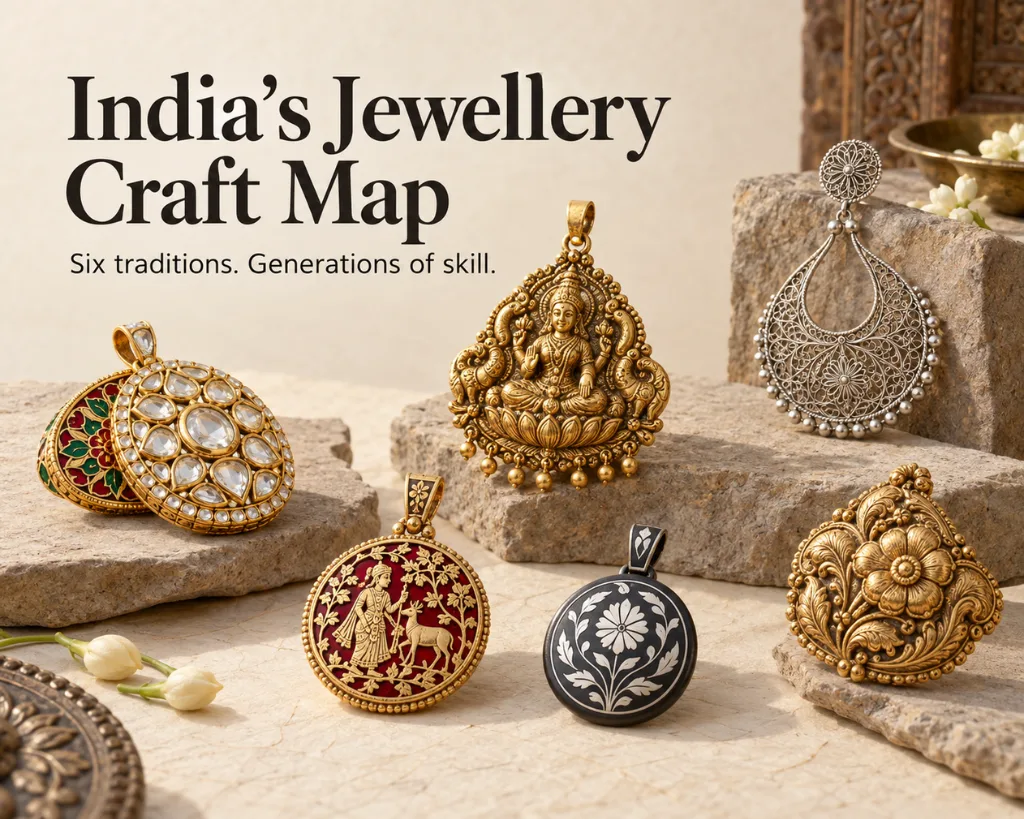
India does not have a jewellery tradition. It has several dozen, each tied to a particular town, a particular material and a particular set of hands, and most of them developed independently of one another. Cataloguing traditional Indian jewellery types by technique rather than by style is the only way the map makes sense, and it explains why a karigar trained in one cluster often cannot work in another. Here are six of the most distinctive, with what each technique actually involves. Kundan and Meenakari, from Jaipur and Bikaner in Rajasthan Kundan is a setting technique, not a stone. Uncut or flat-backed gems, traditionally polki or unfaceted diamond, are bedded into a gold framework using highly refined gold foil, burnished cold around each stone until it grips. Behind the stone sits a lac core, which gives the piece body without the weight of solid gold. The work is done in stages by different specialists: the ghaarai who makes the frame, the paadh who fills it, the chilaisaaz who does the gold work, and the jadiya who sets. Meenakari is the other half of the same tradition. Vitreous enamel is fused into engraved recesses in gold and fired colour by colour, from the most heat-resistant to the least. The reason so much Jaipur kundan meena work is reversible is that the back is enamelled while the front is set. Two complete crafts on one object. Temple jewellery, from Nagercoil and Vadasery in Tamil Nadu Originally made to adorn temple deities and later worn by Bharatanatyam dancers, temple jewellery is built around iconography: Lakshmi faces, peacocks, mango and lotus motifs, swan and serpent forms. It was traditionally executed in high-karat gold set with rubies, emeralds and uncut stones, with a distinctive repoussé relief that gives the metal its sculptural depth. Nagercoil remains the centre of the craft, and the style now reaches a far wider market through gold-plated and silver versions. Silver filigree, or Tarakasi, from Cuttack in Odisha The filigree jewellery Cuttack is known for begins as a silver ingot drawn into wire finer than a hair, then flattened, twisted, coiled and soldered into open lacework with no backing sheet at all. The structure holds only because every joint is sound. A single elaborate piece can take weeks, and the craft has survived over four centuries in the same city, still made in family workshops and still largely without machinery. Thewa, from Pratapgarh in Rajasthan This is the rarest of the six, and the most specific. A wafer-thin sheet of 23K gold is hand-pierced into an intricate figurative scene, such as a court procession, a hunt or a Krishna narrative, and then fused onto coloured glass at high temperature, so the glass glows through the openings in the gold. The process has been held within a single family lineage in Pratapgarh since the eighteenth century, and the number of practising artisans has been in the low dozens for years. Bidri, from Bidar in Karnataka Bidri is metalwork rather than goldsmithing, but it sits in the jewellery and object trade and follows the same logic. A zinc-copper alloy is cast, then engraved and inlaid with fine silver wire or sheet. The finished object is treated with a paste made from soil taken from within Bidar fort, which oxidises the alloy to deep matte black while leaving the silver bright. The soil matters, because it means the craft cannot be relocated, which is precisely what a Geographical Indication tag is designed to recognise. Nakshi, the hand-engraved and repoussé work of Bengal and Eastern India Nakshi refers to hand-engraved and embossed ornamentation, worked with hammer and chisel from the reverse and refined from the front. Bengali karigars have carried this skill across India for generations, and a great deal of what the trade calls “antique finish” gold depends on it. Unlike the other five, Nakshi is not tied to one town. It is a skill set that travelled, and it is the reason karigar migration is such a feature of the Indian jewellery workforce. What the map is really showing Several of these crafts carry Geographical Indication protection, and several are in genuine decline, not because demand has disappeared but because the transmission has broken. These techniques were taught within families over ten to fifteen years. When a younger generation moves into other work, the craft does not shrink gradually. It stops. That is the argument for treating heritage technique as part of formal jewellery education rather than as folklore. A designer who understands how a kundan frame is bedded, or why a filigree joint fails, can design work that karigars can actually execute, and can specify traditional technique in contemporary pieces instead of imitating its appearance in casting. Studying craft, not just style IIGJ students travel to these clusters as part of their coursework. Jaipur students have studied Kundan-Meena at Bikaner, and craft immersion runs through the heritage programming at the campuses. Design history, materials and traditional technique sit inside the B.A. in Gems & Jewellery Design and the B.Des in Jewellery Design rather than being treated as electives. The hand skills these crafts depend on are taught at the bench through the Diploma in Jewellery Manufacturing and the bench work certificate, and working artisans are supported directly through the skilling programmes run with GJEPC. Which campus you study at shapes which traditions you are closest to, and the Jaipur, Mumbai and Udupi campuses each sit in a different craft geography. The campuses page has the full picture, and admissions can advise on intakes.
22K, 18K or 14K: Which Karat for Which Piece, and Why Designers Choose Differently from Buyers
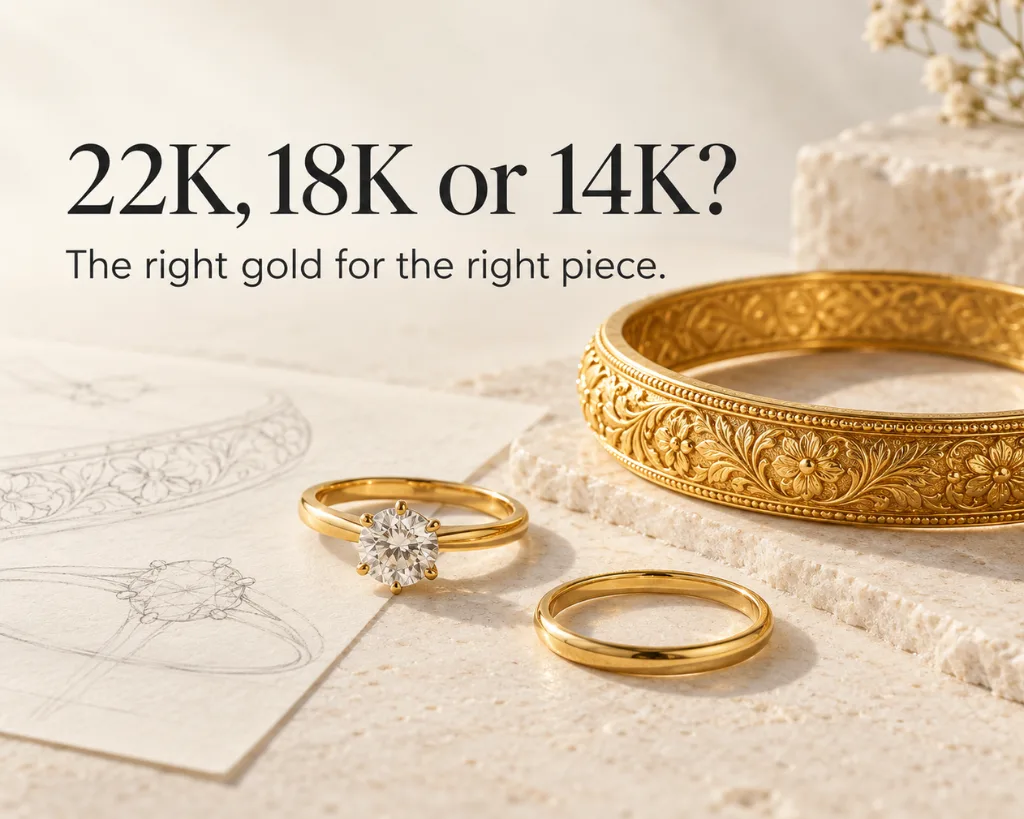
Ask a customer in a jewellery showroom in India which gold is best and the answer is almost always 22K. Ask the designer who made the piece they are holding and you may well get 18K, or 14K for a particular setting. Neither is wrong. They are answering different questions, and the 22k vs 18k gold difference only makes sense once you see which question is being asked. What karat actually measures Karat is a fraction of 24. Pure gold is 24K, and anything less is gold alloyed with other metals. The gold purity chart India uses on hallmarks expresses the same thing as parts per thousand: • 24K is 999 fineness, or 99.9 per cent gold. It is too soft for jewellery that will be worn, and is used for coins and bars. • 23K is 995 fineness, or 99.5 per cent gold. • 22K is 916 fineness, or 91.6 per cent gold. This is the standard for traditional Indian gold jewellery. • 20K is 833 fineness, or 83.3 per cent gold. • 18K is 750 fineness, or 75 per cent gold. This is the international standard for fine and stone-set jewellery. • 14K is 585 fineness, or 58.5 per cent gold. It is common in export, daily-wear and lighter pieces. Those numbers are stamped on every hallmarked piece, and reading them is a two-minute skill worth having. See BIS hallmarking and the six-digit HUID. The buyer’s logic For most Indian buyers, gold jewellery does two jobs at once. It is worn and it is held. A 22K bangle carries more gold per gram, so it retains more value on exchange or resale, and the deep saturated yellow reads unmistakably as gold. For gifting, for wedding sets, and for anything bought partly as a store of value, that logic is sound and nobody should be talked out of it. The trade-off is hardness. At 91.6 per cent gold, 22K is soft. Thin sections bend, edges round off, and prongs holding a stone will loosen faster than the owner expects. It also means a 22K ring worn daily for a decade will show its history. The designer’s logic A designer is not thinking about resale. They are thinking about whether the piece can be made, whether it will survive, and whether the stone will still be in it in five years. That points in a different direction. Alloying is what makes gold workable. The 25 per cent of non-gold in 18K, typically copper, silver, zinc and sometimes palladium, raises hardness substantially, and 14K is harder again. That matters wherever metal has to be thin and do structural work: a micro-pavé band with dozens of tiny beads, a four-prong solitaire head, a hinge, a delicate openwork gallery. In 22K those features deform. In 18K they hold. Alloy also controls colour, which 22K simply cannot deliver. Rose gold comes from a high copper content, white gold from palladium or nickel alloys usually finished with rhodium plating, and green and grey golds from other combinations. Every one of those requires a lower karat. A designer working in 22K has one colour available. And then there is weight. Because gold is dense and priced by the gram, dropping from 22K to 18K lets a designer build a visually larger, more architectural piece at the same cost, or the same piece at a lower one. For fashion-led and export collections that is often the whole commercial case. Which gold karat is best, piece by piece • Wedding and heirloom sets, bangles and chains bought partly as a store of value suit 22K, for its high gold content, traditional colour and better exchange value. • Solitaire rings and anything with a significant centre stone suit 18K, because prongs and bezels in 22K are a long-term security risk. • Micro-pavé, filigree and fine openwork need 18K or 14K, because the structure depends on metal that holds its shape. • Everyday rings, studs, office wear and bracelets that take knocks are better in 18K or 14K for durability. • Rose gold, white gold and any coloured gold require 18K or 14K by necessity. • Pure investment belongs in 24K coins or bars rather than jewellery, since making charges are not recoverable. Three things buyers get wrong First, a higher karat is not a better-made piece. Purity and craftsmanship are unrelated, and a well-finished 18K ring will outlast a poorly made 22K one comfortably. Second, the alloy is not adulteration. A hallmarked 18K750 piece is exactly what it says: three-quarters gold, one quarter working metal, disclosed and assayed. That is engineering, not dilution. Third, “KDM” is not a purity grade. It described gold soldered with cadmium, a practice phased out on health grounds in favour of cadmium-free solder. If a seller offers KDM in place of a hallmark, they are substituting a retired term for a certification. Why students are taught both sides of this Karat selection is one of the first places a design student discovers that aesthetics, metallurgy and cost are the same conversation. You cannot specify a setting without knowing what the alloy will do under a setter’s tool, and you cannot price a collection without knowing what karat does to weight. That is why metals and alloys, casting behaviour and costing run alongside design studio work across IIGJ’s institutes, in the B.A. in Gems & Jewellery Design at Mumbai, the B.Des in Jewellery Design at Jaipur and Delhi, the Diploma in Jewellery Design and the Diploma in Jewellery Manufacturing, and why students spend time in the manufacturing workshop rather than only in front of a screen. The full sequence is laid out in inside the bench. For anyone heading towards valuation or the retail counter, the gold appraiser and retail training covers purity from the other direction. The full list of programmes, and where each one runs, is on the programs page.
Inside the Bench: What Happens Between a CAD File and a Finished Ring
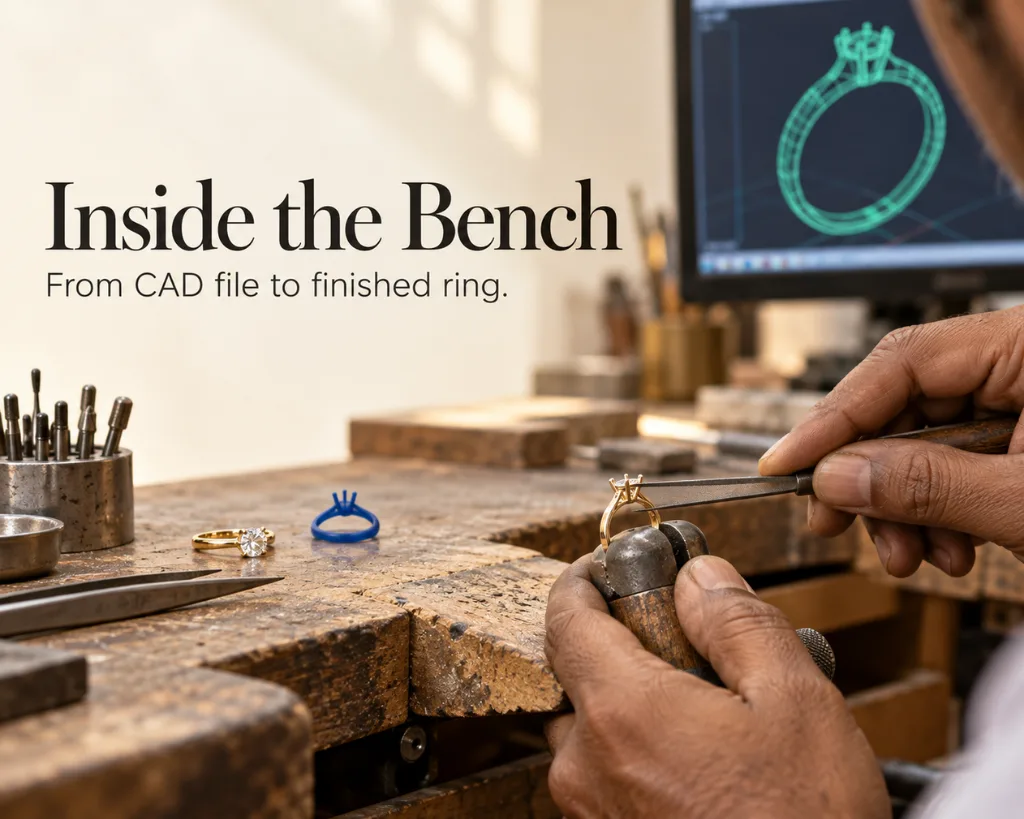
Most students begin a jewellery design programme imagining the job is drawing. Then they watch a ring being made and realise the drawing was about a fifth of it. Between an approved CAD file and a finished piece sit ten or eleven distinct operations, most of them done by hand, each capable of ruining the work done before it. Understanding that sequence is what separates a designer whose files can be manufactured from one whose cannot. Here is the jewellery manufacturing process, step by step, as it runs on a working floor. 1. Brief, Sketch and Specification Before any software opens, the piece is defined: metal and karat, stone sizes and shapes, finger size, target weight, and the price band it has to land in. Weight is the constraint that decides almost everything downstream, because metal is the dominant cost. A designer who ignores it produces beautiful files nobody can sell. Hand sketching still comes first in most studios, because the thinking is faster on paper. 2. CAD Modelling The piece is built in three dimensions, usually in Rhino, Matrix or MatrixGold. This is where design becomes engineering: prong thickness, seat depth for each stone, wall thickness that will survive polishing, shank profile against the finger, and clearance for a setter’s tools. Software choice matters less than the discipline, though it does matter for employability. 3. Rendering and Approval A photorealistic render goes to the client or merchandiser for sign-off, along with an estimated metal weight and stone list. Changes are cheap here and expensive after casting. This is also where costing is confirmed. 4. Growing the Pattern The digital model becomes a physical one. Most floors now 3D print it in castable resin, while some still cut wax on a CNC mill. Either way the output is a pattern, an exact replica of the final piece in a material that will burn away cleanly. Print orientation and support placement are a craft of their own, because every support leaves a mark someone has to file off. 5. Tree, invest and burn out Patterns are attached by wax sprues to a central stem, forming a “tree”, and sealed inside a steel flask. Liquid investment plaster is poured around the tree under vacuum to eliminate air bubbles, then left to set. The flask goes into a burnout oven, which is ramped up over several hours. The resin or wax vaporises, leaving a negative cavity in hardened plaster. That cavity is the mould. 6. Casting The jewellery casting process is where the piece first exists in metal. Alloy is melted and forced into the hot flask, either by centrifugal spin or under vacuum pressure. The flask is quenched, the plaster breaks away, and what emerges is a tree of rough metal castings. Porosity, incomplete fills and shrinkage all show up here, and all of them trace back to something decided earlier: a wall too thin, a sprue too narrow, a burnout run too fast. 7. Cutting, filing and pre-polish Castings are cut from the tree and the sprue stubs filed flush. Then comes the least glamorous and most decisive stage of bench jeweller work: files, burrs, emery and rubber wheels, working every surface until the form is true and the seats are clean. A piece that is not properly prepared here can never be rescued by final polishing. Most of what a viewer reads as “quality” in finished jewellery was decided at this bench. 8. Assembly and Soldering Multi-part pieces are fitted and joined, including jump rings, bails, hinges, clasps and gallery components. Solder has to flow at a temperature that will not slump the parent metal, and joints must sit where stress will not find them. Cadmium-bearing solder, the old “KDM” practice, has been phased out on health grounds in favour of cadmium-free alloys. 9. Stone Setting This is the highest-skill operation on the floor, and where value is most easily destroyed. A chipped centre stone at this stage is a write-off. Setters work under a microscope or loupe, cutting seats and moving metal over each stone. The main techniques are these: • Prong or claw setting bends metal claws over the stone, giving maximum light and minimum protection. • Bezel setting surrounds the stone with a rim of metal, and it is the most secure of the group. • Pavé and micro-pavé hold many small stones with tiny shared beads, giving a continuous surface of stone. • Channel setting holds stones between two parallel walls with no metal between them. • Flush or gypsy setting sinks the stone level with the metal surface. 10. Final Polish and Plating The piece is polished through progressively finer compounds, then cleaned ultrasonically and steamed. White gold is usually rhodium plated for whiteness, and some pieces get matte, hammered or sandblasted finishes, which have to be masked and applied after polishing. Care is needed around softer stones, since emerald, opal and pearl should never see an ultrasonic bath, a point we go into in how to look after jewellery at home. 11. Quality control, hallmarking and certification Final inspection checks stone security, finger size, weight against specification, symmetry and finish. Gold is then sent for assaying and hallmarking, returning with the BIS mark, purity grade and a six-digit HUID, the marks explained in BIS hallmarking and the six-digit HUID. Diamond pieces may also go for certification. Why designers are taught to do this by hand None of these stages can be learned from a screen. Students at IIGJ work at the bench, in the casting room and under the setter’s microscope alongside their CAD training, because a designer who has filed a casting and set a stone designs differently, and better, afterwards. The Diploma in Jewellery Manufacturing, the bench work certificate and the metal setting certificate each focus on part of this chain, while the B.A. in Gems & Jewellery Design and B.Des in Jewellery Design covers the whole of it across three years. Diploma, postgraduate diploma and certificate programmes run across IIGJ’s
Lab-Grown and Natural Diamonds in India: How They Are Made, How They Are Graded, and What It Means for a Career
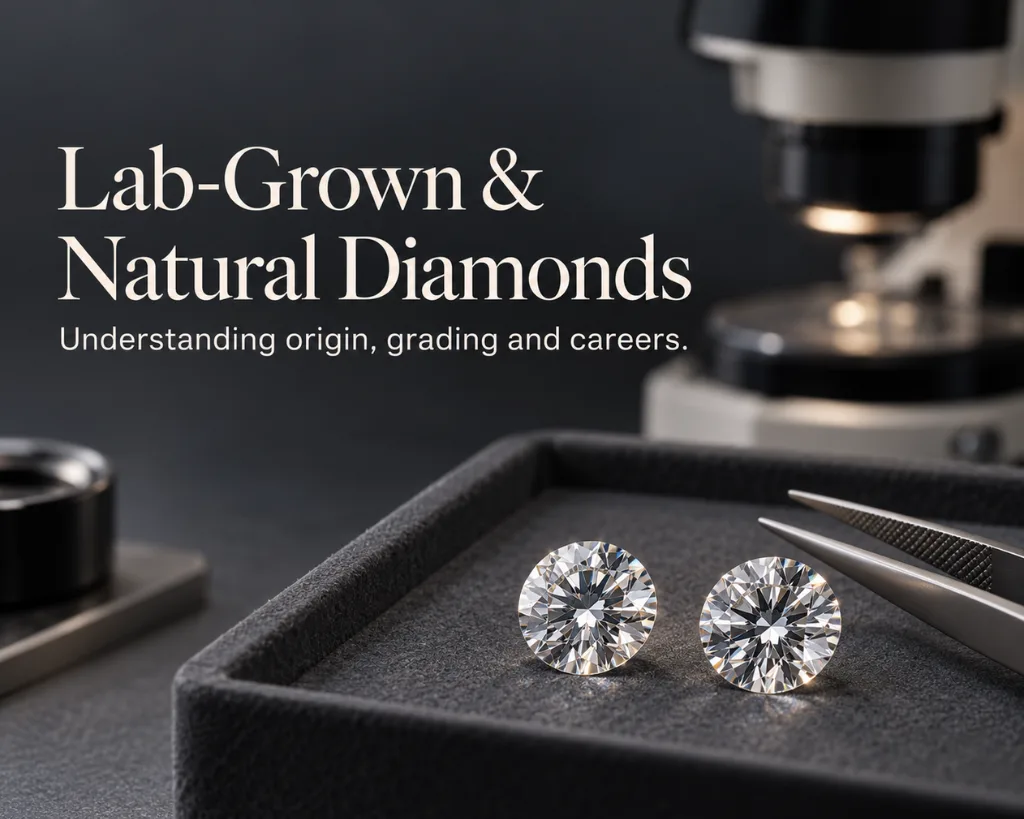
Few questions come up at a jewellery counter as often as lab grown vs natural diamonds, and few get a clear answer. Look at how each stone is made and graded and the technical position is unusually clear, and far more interesting than the debate suggests. It also matters professionally, because India sits at the centre of both trades, and the skills the sector is hiring for have shifted in the last five years. Are lab grown diamonds real diamonds? Yes, in the only sense that means anything scientifically. A lab-grown diamond is carbon crystallised in the cubic diamond lattice. It has the same hardness, 10 on the Mohs scale, along with the same refractive index, the same dispersion and the same thermal conductivity as a mined diamond. It is not a simulant. Cubic zirconia and moissanite are different materials that imitate the look of diamond, whereas a lab-grown diamond is diamond. What differs is origin and, consequently, rarity. A natural diamond crystallised in the mantle over geological time. A lab-grown diamond was produced in a reactor in a matter of weeks. Both are diamond, but only one is scarce, and price follows scarcity rather than chemistry. CVD versus HPHT: The two ways a diamond is grown The CVD vs HPHT diamonds distinction is about production method, not quality. Both routes produce gem-quality material and both produce poor material. HPHT, which stands for High Pressure High Temperature, reproduces mantle conditions. A diamond seed, a carbon source and metal flux are subjected to pressures above 5 GPa and temperatures around 1,400°C in a press, and carbon crystallises onto the seed. HPHT growth tends to produce cuboctahedral crystals and can leave metallic flux inclusions, which is one of the tells gemmologists look for. CVD, or Chemical Vapour Deposition, takes the opposite approach. A diamond seed plate sits in a vacuum chamber filled with a carbon-rich gas, usually methane and hydrogen. The gas is energised into a plasma, carbon atoms settle onto the seed, and the crystal grows upward in layers. CVD produces tabular crystals and characteristic striated growth, and it is the dominant method in Indian production. HPHT is also used as a treatment on both natural and CVD-grown stones to improve colour, which is a separate disclosure issue from how the stone originated. How a laboratory tells them apart Not by eye, and not with a loupe. A well-cut lab-grown diamond is visually indistinguishable from a natural one, and any retailer claiming otherwise is guessing. Separation is an instrument job, resting on features that record how the crystal grew: • Growth structure and strain patterns, viewed under cross-polarised light. Natural diamonds show characteristic irregular strain, while CVD stones show a banded pattern. • Fluorescence and phosphorescence behaviour under short-wave ultraviolet, which differs markedly between HPHT, CVD and natural material. • Photoluminescence spectroscopy, which identifies defect centres specific to synthetic growth and is the reference method for difficult stones. • Trace elements, such as nitrogen distribution in natural diamond and boron or metallic flux signatures in some synthetics. • Screening instruments, which sort a parcel rapidly into “natural” and “refer for testing” rather than delivering a final verdict themselves. Both categories are graded on the familiar 4Cs, and a lab report for a grown stone must state that the diamond is laboratory-grown, along with any treatment. If reading a grading report is unfamiliar territory, start with the importance of gemstone certifications and how to interpret them and our explainer on diamond weight, measurement and size. Where India fits India has cut and polished the overwhelming majority of the world’s natural diamonds for decades, with Surat as the centre of that industry. Over the past few years the same infrastructure of skilled cutters, laser sawing, planning software and polishing capacity has been turned to lab-grown material, and India has become one of the largest producers and processors of lab-grown diamonds. That is unusual, because most countries participate in one side of this market rather than both. As capacity has expanded, the lab-grown segment has increasingly separated into its own product category, with its own customers and its own margins, rather than competing head-on with mined goods. What it means for a career The growth of lab-grown material has not replaced jobs in the diamond pipeline. It has added categories. Screening and verification is now a distinct technical role, because every parcel entering a factory or a retail chain has to be sorted before it is valued. Grading laboratories need gemmologists who can work confidently with both origins. Manufacturers need planners and quality staff familiar with CVD growth characteristics. And retail needs people who can explain the difference to a customer without overselling either side, currently the scarcest skill of the lot. IIGJ has partnered with InCent LGD (IIT Madras) to strengthen lab grown diamond education in India, and diamond grading sits at the centre of several programmes: the Professional Certificate in Diamonds and Diamond Grading, the Diploma in Gemmology and the design and manufacturing degrees, where students handle diamonds. You can see how the programmes are structured on the programs page, read about outcomes on placements, or follow developments through news and articles. The honest summary for a student is this. It is not a controversy to pick a side in. It is a second market that has appeared alongside the first, and the people who understand both will be the ones the industry competes to hire.