

If you have just finished school and jewellery design has caught your interest, the first thing worth knowing is that there is no single route in. There are four, they suit very different people, and the difference between them is not prestige. It is time, depth and what you want to be doing in three years. Here is what a jewellery design course after 12th actually looks like at each level.
First, the eligibility question
The jewellery design eligibility bar is lower than most students expect. For degree and diploma programmes at IIGJ, you need 10+2 from any recognised central or state board, in any stream. The courses after 12th arts commerce science students take are the same courses. There is no science requirement, no mathematics cut-off and no stream restriction.
There is also no national entrance examination for jewellery design of the kind that governs engineering or medicine. Admission is generally by application, with an interaction or interview and, where relevant, a look at whatever creative work you have. Which leads to the question every applicant asks.
Do you need to be able to draw?
No, not to be admitted. Drawing is taught from the ground up, and every cohort includes students who arrived unable to render a straight line. What is not taught is interest: the willingness to look closely at objects, to redraw something eleven times, and to care about a two-millimetre difference. Students who have that overtake naturally gifted sketchers within a year, consistently.
If you do have work, whether sketchbooks, craft projects or anything made by hand, bring it. It helps the conversation. It is not a gate.
Route one: A degree
This is the fullest route, and the right one if you are coming straight from school with three or four years to give it. A degree covers everything: design fundamentals, hand rendering, CAD, manufacturing, gemmology and diamond grading, merchandising and management, plus an industry internship and a graduating collection.
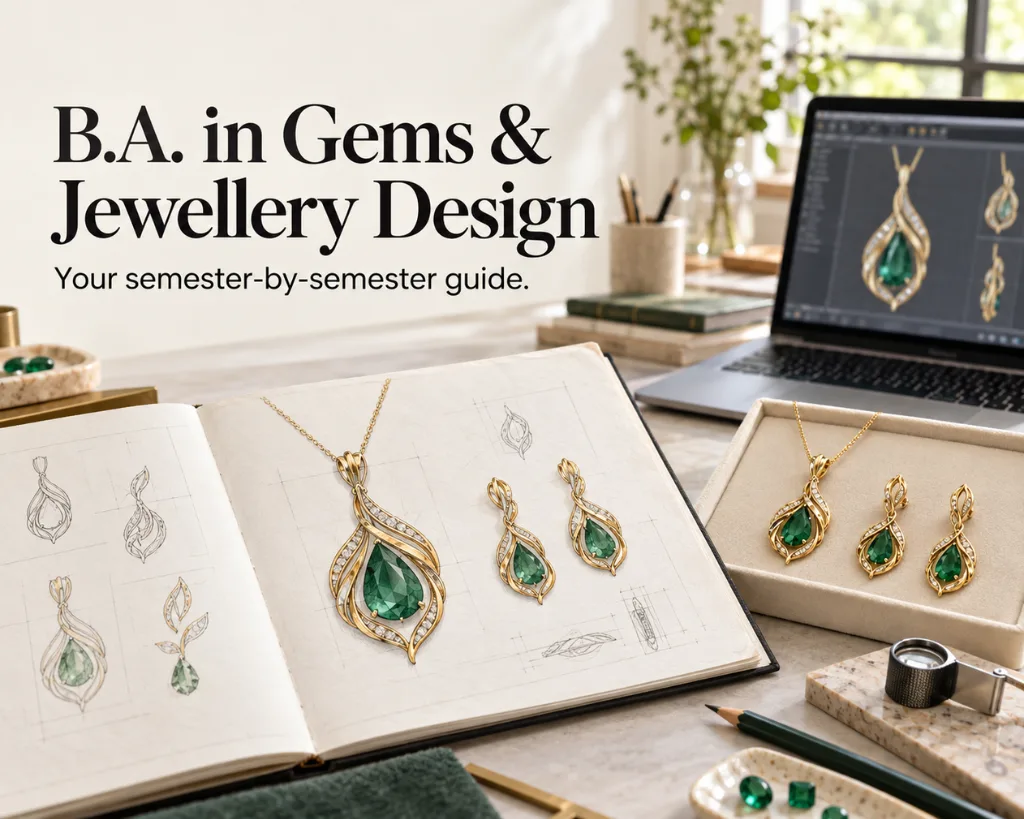
IIGJ runs the B.A. in Gems & Jewellery Design as a three-year programme at Mumbai and the B.Des in Jewellery Design at Jaipur and Delhi, and all of them are university-affiliated degrees. A degree gives you a recognised qualification, the option of postgraduate study later, and, the part students underestimate, three years to actually become good rather than six months to become employable. If you want to see what the three years contain term by term, we have broken it down in what a B.A. in Gems & Jewellery Design actually covers.
Route two: A diploma
This route is shorter and more focused, and it is the right call if you want to be working sooner or already know which part of the trade you want. Diplomas at IIGJ take 10+2 from any board and specialise from the start:
• The Diploma in Jewellery Design covers design principles, trends, materials and CAD-CAM.
• The Diploma in Jewellery Manufacturing covers the bench, casting, finishing and production.
• The Diploma in Gemmology covers diamonds and coloured stones, grading and identification.
• The Diploma in Computer Aided Design covers Rhino and Matrix for jewellery, to a professional standard.
• The Master Gemmologist Programme covers gem identification with instruments, for the laboratory and valuation side.
A diploma trades breadth for speed. You will be job-ready in a defined role rather than broadly educated across the industry.
Route three: A professional certificate
These are short, single-skill courses, and they are genuinely useful in three situations. You want to test whether this industry suits you before committing years. You are joining a family jewellery business and need specific knowledge quickly. Or you already work in the trade and need one capability added.
The professional certificate courses cover individual skills, including CAD in Rhino, diamond grading, gem identification, bench work, metal setting, merchandising and Navratnas. They also stack: several certificates taken over time build into a real skill profile.
Where each one leads
Jewellery design is one entry point to an industry with a lot of doors. Graduates work as designers and CAD artists, as merchandisers and product development executives with manufacturers and exporters, as gemmologists and graders in laboratories, as valuers, in retail and store management, in sourcing, and in their own labels. The industry-side view is set out in why the jewellery industry is a brilliant career choice, and placements shows where IIGJ graduates have gone.
Choosing, practically
If you have three years, take the degree. If you are clear about one specialism and want to work sooner, take the diploma in that area. If you are testing the water, or adding a skill to something you already do, take a certificate.
Location matters too, since IIGJ runs Institute in Mumbai, Delhi, Jaipur, Udupi, Guwahati, Varanasi and Ratnagiri, and not every programme runs everywhere, so the institutes page has the details. If you are still weighing formats, diploma, degree or certificate compares them directly, and admissions will tell you what the current intake looks like.