


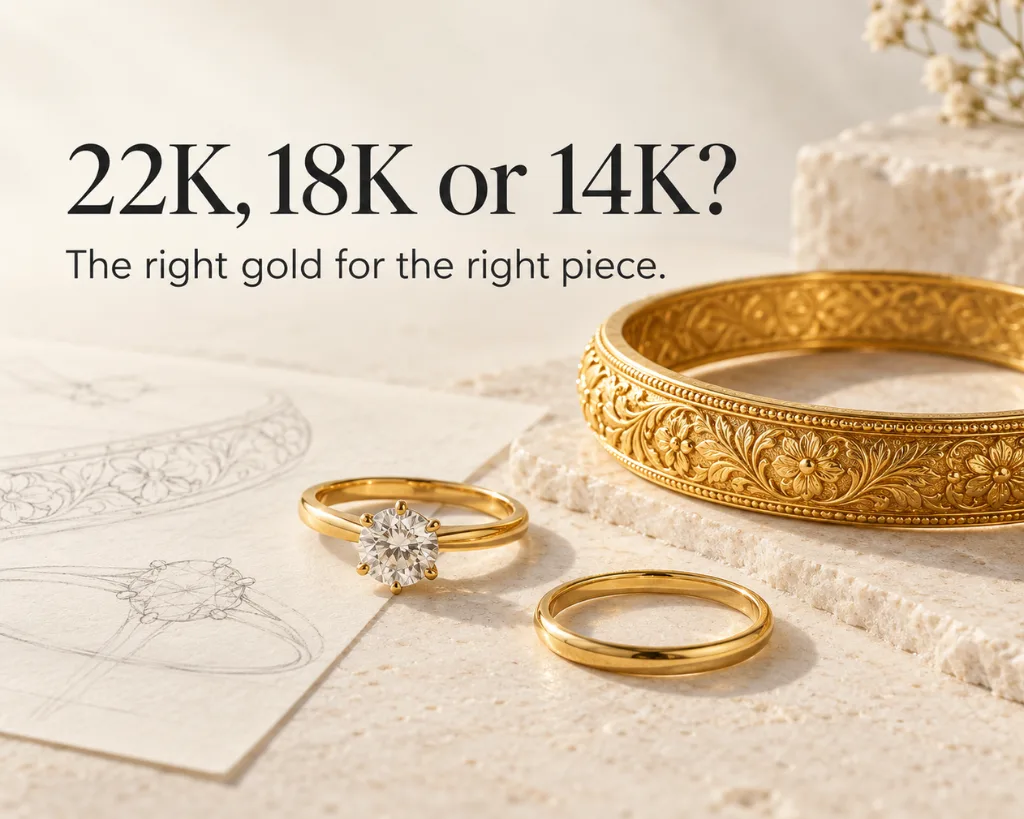
Ask a customer in a jewellery showroom in India which gold is best and the answer is almost always 22K. Ask the designer who made the piece they are holding and you may well get 18K, or 14K for a particular setting. Neither is wrong. They are answering different questions, and the 22k vs 18k gold difference only makes sense once you see which question is being asked.
What karat actually measures
Karat is a fraction of 24. Pure gold is 24K, and anything less is gold alloyed with other metals. The gold purity chart India uses on hallmarks expresses the same thing as parts per thousand:
• 24K is 999 fineness, or 99.9 per cent gold. It is too soft for jewellery that will be worn, and is used for coins and bars.
• 23K is 995 fineness, or 99.5 per cent gold.
• 22K is 916 fineness, or 91.6 per cent gold. This is the standard for traditional Indian gold jewellery.
• 20K is 833 fineness, or 83.3 per cent gold.
• 18K is 750 fineness, or 75 per cent gold. This is the international standard for fine and stone-set jewellery.
• 14K is 585 fineness, or 58.5 per cent gold. It is common in export, daily-wear and lighter pieces.
Those numbers are stamped on every hallmarked piece, and reading them is a two-minute skill worth having. See BIS hallmarking and the six-digit HUID.
The buyer’s logic
For most Indian buyers, gold jewellery does two jobs at once. It is worn and it is held. A 22K bangle carries more gold per gram, so it retains more value on exchange or resale, and the deep saturated yellow reads unmistakably as gold. For gifting, for wedding sets, and for anything bought partly as a store of value, that logic is sound and nobody should be talked out of it.
The trade-off is hardness. At 91.6 per cent gold, 22K is soft. Thin sections bend, edges round off, and prongs holding a stone will loosen faster than the owner expects. It also means a 22K ring worn daily for a decade will show its history.
The designer’s logic
A designer is not thinking about resale. They are thinking about whether the piece can be made, whether it will survive, and whether the stone will still be in it in five years. That points in a different direction.
Alloying is what makes gold workable. The 25 per cent of non-gold in 18K, typically copper, silver, zinc and sometimes palladium, raises hardness substantially, and 14K is harder again. That matters wherever metal has to be thin and do structural work: a micro-pavé band with dozens of tiny beads, a four-prong solitaire head, a hinge, a delicate openwork gallery. In 22K those features deform. In 18K they hold.
Alloy also controls colour, which 22K simply cannot deliver. Rose gold comes from a high copper content, white gold from palladium or nickel alloys usually finished with rhodium plating, and green and grey golds from other combinations. Every one of those requires a lower karat. A designer working in 22K has one colour available.
And then there is weight. Because gold is dense and priced by the gram, dropping from 22K to 18K lets a designer build a visually larger, more architectural piece at the same cost, or the same piece at a lower one. For fashion-led and export collections that is often the whole commercial case.
Which gold karat is best, piece by piece
• Wedding and heirloom sets, bangles and chains bought partly as a store of value suit 22K, for its high gold content, traditional colour and better exchange value.
• Solitaire rings and anything with a significant centre stone suit 18K, because prongs and bezels in 22K are a long-term security risk.
• Micro-pavé, filigree and fine openwork need 18K or 14K, because the structure depends on metal that holds its shape.
• Everyday rings, studs, office wear and bracelets that take knocks are better in 18K or 14K for durability.
• Rose gold, white gold and any coloured gold require 18K or 14K by necessity.
• Pure investment belongs in 24K coins or bars rather than jewellery, since making charges are not recoverable.
Three things buyers get wrong
First, a higher karat is not a better-made piece. Purity and craftsmanship are unrelated, and a well-finished 18K ring will outlast a poorly made 22K one comfortably.
Second, the alloy is not adulteration. A hallmarked 18K750 piece is exactly what it says: three-quarters gold, one quarter working metal, disclosed and assayed. That is engineering, not dilution.
Third, “KDM” is not a purity grade. It described gold soldered with cadmium, a practice phased out on health grounds in favour of cadmium-free solder. If a seller offers KDM in place of a hallmark, they are substituting a retired term for a certification.
Why students are taught both sides of this
Karat selection is one of the first places a design student discovers that aesthetics, metallurgy and cost are the same conversation. You cannot specify a setting without knowing what the alloy will do under a setter’s tool, and you cannot price a collection without knowing what karat does to weight.
That is why metals and alloys, casting behaviour and costing run alongside design studio work across IIGJ’s institutes, in the B.A. in Gems & Jewellery Design at Mumbai, the B.Des in Jewellery Design at Jaipur and Delhi, the Diploma in Jewellery Design and the Diploma in Jewellery Manufacturing, and why students spend time in the manufacturing workshop rather than only in front of a screen. The full sequence is laid out in inside the bench. For anyone heading towards valuation or the retail counter, the gold appraiser and retail training covers purity from the other direction. The full list of programmes, and where each one runs, is on the programs page.