


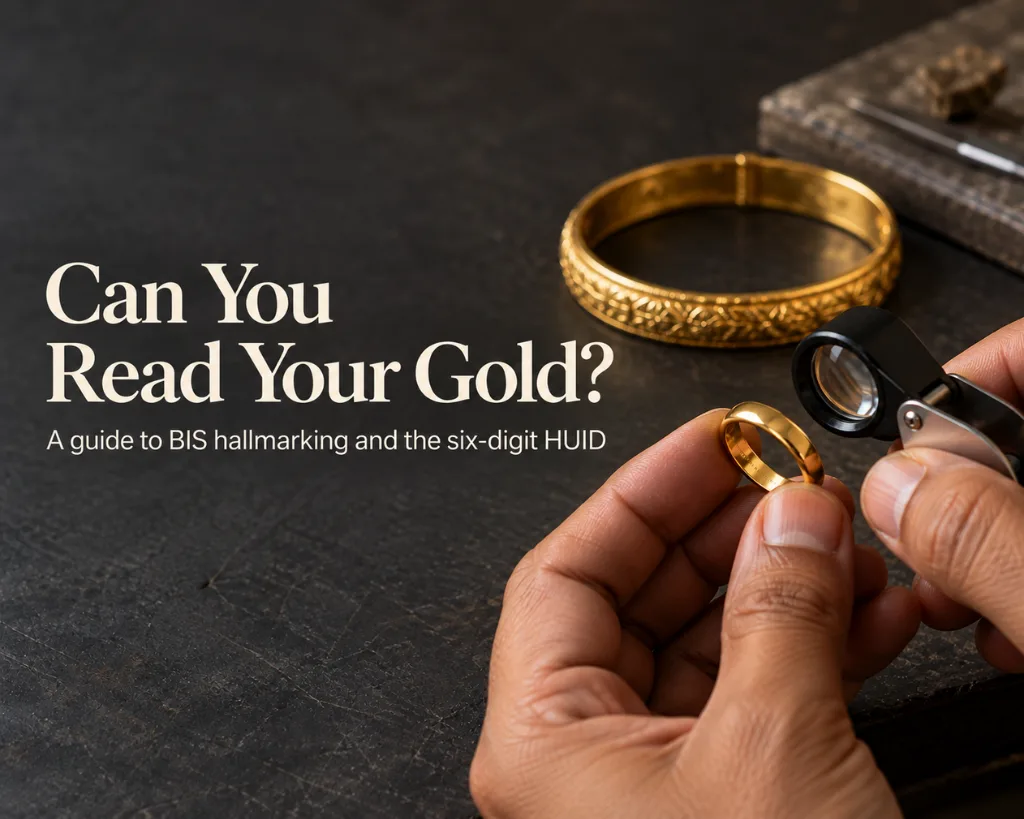
Almost every gold buyer in India has now heard that jewellery must be hallmarked. Far fewer can actually read the marks. The stamps are tiny, they are usually tucked inside a bangle or on the back of a pendant, and the shop rarely walks you through them. Yet those three marks are the only independent statement of purity you will ever get on a piece of gold, and learning to read them takes about two minutes.
A BIS hallmark on gold in India is not a brand, a guarantee of workmanship, or a valuation. It certifies one thing: that a sample from the piece was assayed at a BIS-recognised centre and found to contain the fineness of gold stamped on it. That is a narrower promise than most buyers assume, and a more useful one.
The Three Marks on a Hallmarked Piece
The hallmark was simplified in 2021. Older jewellery may carry four or five stamps, including the jeweller’s identification mark and the assaying centre’s mark. Anything hallmarked under the current system carries three:
- The BIS standard mark is a small triangle. It is the logo of the Bureau of Indian Standards, and it confirms the piece went through a recognised assaying and hallmarking centre.
- The purity or fineness grade is the number that tells you how much gold is actually in the alloy.
- The six-digit alphanumeric HUID is a unique code assigned to that specific piece.
If any of the three is missing on gold jewellery bought new in a notified district, that is your first question at the counter, not an afterthought.
Reading the purity grade: What 916 actually means
The 916 hallmark meaning is the one buyers ask about most, and it is straightforward. The number is parts of gold per thousand. So:
• 22K is stamped 22K916, which is 91.6 per cent gold
• 18K is stamped 18K750, which is 75 per cent gold
• 14K is stamped 14K585, which is 58.5 per cent gold
• 20K is stamped 20K833, 23K is stamped 23K995, and 24K is stamped 24K999
The remaining percentage is alloy, usually copper, silver, zinc or palladium, and it is not an impurity. It is what makes gold hard enough to hold a stone or survive daily wear. Which karat suits which piece is a design decision as much as a purity one, and we have written about that trade-off separately in 22K, 18K or 14K: which karat for which piece.
What the six-digit HUID is, and What it is not
HUID stands for Hallmark Unique Identification. It is a six-digit alphanumeric code assigned to an individual article at the time of hallmarking, and no two pieces share one. Since April 2023, gold jewellery sold in notified districts must carry it.
The HUID number meaning is often misread in two directions. It is not a purity grade, because the fineness is a separate mark. And it is not a certificate of quality, weight or design origin. What it is, is traceability: the code links the piece back to a record showing which jeweller registered it, which centre hallmarked it, and what purity it was assayed at. That record is what makes the mark verifiable rather than decorative.
How to check a hallmark on gold in under a minute
Anyone can verify a HUID without visiting a lab. The BIS Care app, published by the Bureau of Indian Standards and available free on both mobile platforms, has a “Verify HUID” function. You enter the six-digit code and it returns the registered jeweller, the hallmarking centre, the article type, its purity and the date it was hallmarked.
Three habits make this useful rather than a party trick. Read the HUID off the piece yourself under the shop’s loupe, not from the invoice. Check that the purity the app returns matches both the stamp and the rate you are charged. And confirm the article description matches what is in your hand, because a code registered against a chain should not turn up on a ring.
When the numbers do not match
A mismatch is not always fraud. Codes get mistyped on invoices, and app records occasionally lag. But a HUID that returns nothing, returns a different purity, or returns a different article is a reason to pause the purchase rather than negotiate around it. Ask for the hallmarking certificate, ask which centre assayed the piece, and if the answers are vague, walk. Consumers can also raise a complaint through BIS directly. That mechanism exists precisely because the mark is meant to be checkable by the buyer, not only by the trade.
One older practice worth knowing: gold sold as “KDM” was soldered with cadmium, a hazardous method since phased out. KDM is not a purity grade, and it never substitutes for a hallmark.
Why this belongs in a jeweller’s training, not just a buyer’s
From the other side of the counter, hallmark literacy is a sales skill. A salesperson who can hand a customer a loupe, point out the triangle, explain 916 against 750 and pull up the HUID on the app closes high-value gold purchases that a scripted pitch loses. It converts suspicion into confidence, which is the actual job on a gold counter.
That is why purity, assaying and valuation sit inside the gold appraiser and retail training programmes at IIGJ rather than being treated as back-office knowledge, and why diamond and gemstone grading runs through the Diploma in Gemmology and the professional certificate courses. If you are weighing a career on the technical side of the trade, the gemmology and gem identification route is where this kind of reading becomes a profession.
Learning to read three small stamps will not make anyone a gemmologist. It will, however, mean you never again buy gold on trust alone. And if you are considering the industry as a career, it is the first piece of professional knowledge worth owning. You can see the full range of programmes on the programs page or start an enquiry through admissions.