


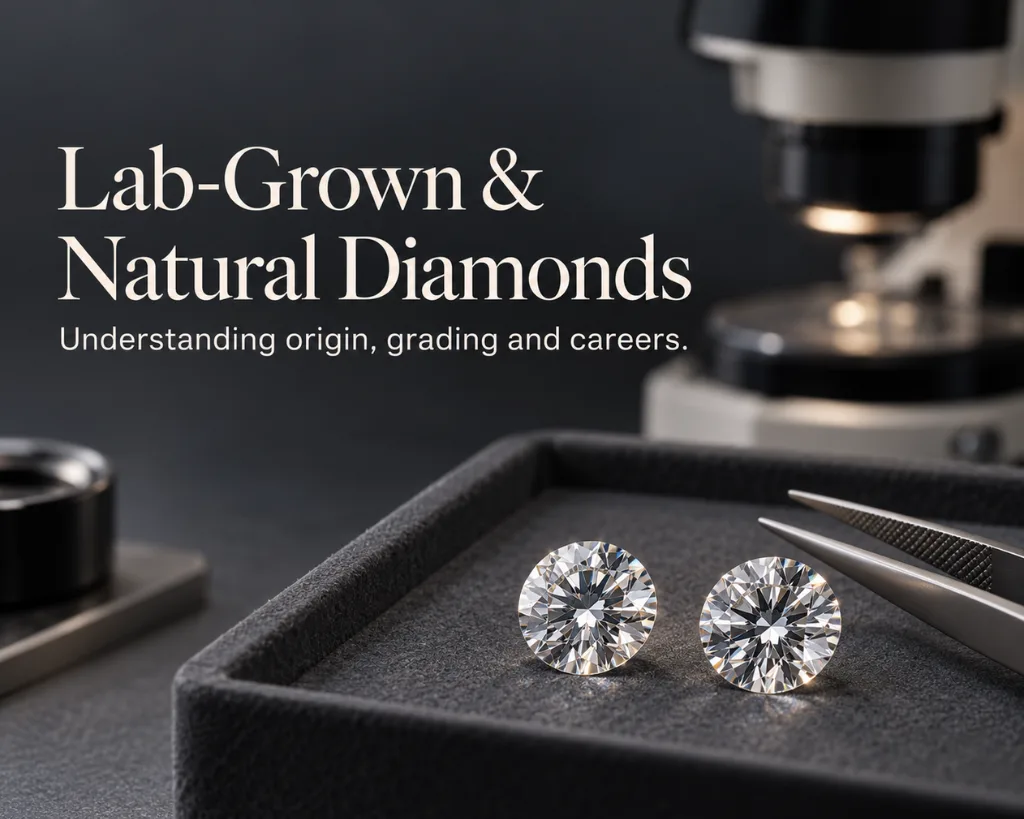
Few questions come up at a jewellery counter as often as lab grown vs natural diamonds, and few get a clear answer. Look at how each stone is made and graded and the technical position is unusually clear, and far more interesting than the debate suggests. It also matters professionally, because India sits at the centre of both trades, and the skills the sector is hiring for have shifted in the last five years.
Are lab grown diamonds real diamonds?
Yes, in the only sense that means anything scientifically. A lab-grown diamond is carbon crystallised in the cubic diamond lattice. It has the same hardness, 10 on the Mohs scale, along with the same refractive index, the same dispersion and the same thermal conductivity as a mined diamond. It is not a simulant. Cubic zirconia and moissanite are different materials that imitate the look of diamond, whereas a lab-grown diamond is diamond.
What differs is origin and, consequently, rarity. A natural diamond crystallised in the mantle over geological time. A lab-grown diamond was produced in a reactor in a matter of weeks. Both are diamond, but only one is scarce, and price follows scarcity rather than chemistry.
CVD versus HPHT: The two ways a diamond is grown
The CVD vs HPHT diamonds distinction is about production method, not quality. Both routes produce gem-quality material and both produce poor material.
HPHT, which stands for High Pressure High Temperature, reproduces mantle conditions. A diamond seed, a carbon source and metal flux are subjected to pressures above 5 GPa and temperatures around 1,400°C in a press, and carbon crystallises onto the seed. HPHT growth tends to produce cuboctahedral crystals and can leave metallic flux inclusions, which is one of the tells gemmologists look for.
CVD, or Chemical Vapour Deposition, takes the opposite approach. A diamond seed plate sits in a vacuum chamber filled with a carbon-rich gas, usually methane and hydrogen. The gas is energised into a plasma, carbon atoms settle onto the seed, and the crystal grows upward in layers. CVD produces tabular crystals and characteristic striated growth, and it is the dominant method in Indian production.
HPHT is also used as a treatment on both natural and CVD-grown stones to improve colour, which is a separate disclosure issue from how the stone originated.
How a laboratory tells them apart
Not by eye, and not with a loupe. A well-cut lab-grown diamond is visually indistinguishable from a natural one, and any retailer claiming otherwise is guessing. Separation is an instrument job, resting on features that record how the crystal grew:
• Growth structure and strain patterns, viewed under cross-polarised light. Natural diamonds show characteristic irregular strain, while CVD stones show a banded pattern.
• Fluorescence and phosphorescence behaviour under short-wave ultraviolet, which differs markedly between HPHT, CVD and natural material.
• Photoluminescence spectroscopy, which identifies defect centres specific to synthetic growth and is the reference method for difficult stones.
• Trace elements, such as nitrogen distribution in natural diamond and boron or metallic flux signatures in some synthetics.
• Screening instruments, which sort a parcel rapidly into “natural” and “refer for testing” rather than delivering a final verdict themselves.
Both categories are graded on the familiar 4Cs, and a lab report for a grown stone must state that the diamond is laboratory-grown, along with any treatment. If reading a grading report is unfamiliar territory, start with the importance of gemstone certifications and how to interpret them and our explainer on diamond weight, measurement and size.
Where India fits
India has cut and polished the overwhelming majority of the world’s natural diamonds for decades, with Surat as the centre of that industry. Over the past few years the same infrastructure of skilled cutters, laser sawing, planning software and polishing capacity has been turned to lab-grown material, and India has become one of the largest producers and processors of lab-grown diamonds. That is unusual, because most countries participate in one side of this market rather than both.
As capacity has expanded, the lab-grown segment has increasingly separated into its own product category, with its own customers and its own margins, rather than competing head-on with mined goods.
What it means for a career
The growth of lab-grown material has not replaced jobs in the diamond pipeline. It has added categories. Screening and verification is now a distinct technical role, because every parcel entering a factory or a retail chain has to be sorted before it is valued. Grading laboratories need gemmologists who can work confidently with both origins. Manufacturers need planners and quality staff familiar with CVD growth characteristics. And retail needs people who can explain the difference to a customer without overselling either side, currently the scarcest skill of the lot.
IIGJ has partnered with InCent LGD (IIT Madras) to strengthen lab grown diamond education in India, and diamond grading sits at the centre of several programmes: the Professional Certificate in Diamonds and Diamond Grading, the Diploma in Gemmology and the design and manufacturing degrees, where students handle diamonds. You can see how the programmes are structured on the programs page, read about outcomes on placements, or follow developments through news and articles.
The honest summary for a student is this. It is not a controversy to pick a side in. It is a second market that has appeared alongside the first, and the people who understand both will be the ones the industry competes to hire.