


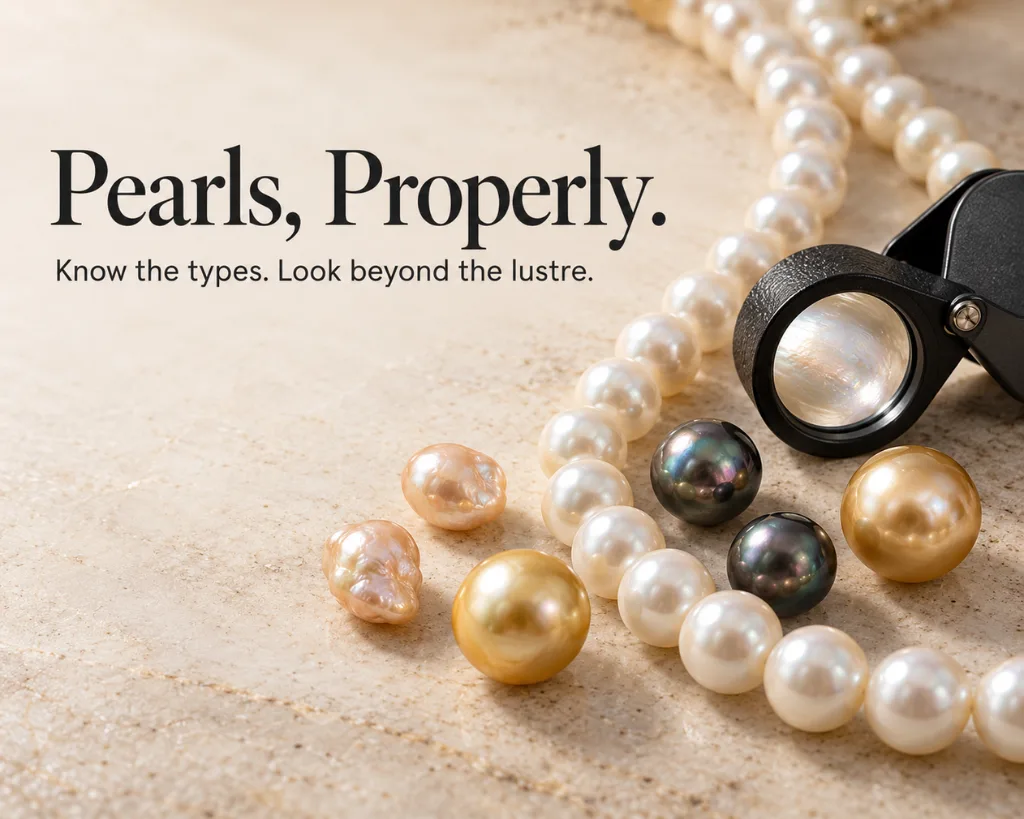
Pearls are the one gem most Indian households already own and almost nobody can classify. A strand comes down through a family, gets described as “Basra” or “real”, and is never examined again. Meanwhile the market carries at least four genuinely different products under the same word, priced anywhere from a few hundred rupees to several lakhs. Knowing which is which is basic consumer literacy.
Unlike every other gem in the trade, a pearl is not mined and not cut. It grows inside a living mollusc, layer by layer, as nacre is deposited around an irritant. Its lustre, its surface and its durability all come from that nacre. Which is why learning how to identify real pearls starts with understanding how the nacre got there.
Natural versus cultured: The distinction that sets the price
A natural pearl forms without human involvement, when an irritant enters a mollusc by chance. These are extraordinarily rare. Historic Gulf fisheries, the source of what the Indian trade calls Basra pearls, are largely exhausted. That is why genuine natural pearls of any size now belong to the auction market rather than the retail one.
A cultured pearl is grown in a farmed mollusc after a technician surgically inserts a nucleus, usually a shell bead, along with mantle tissue. The mollusc then does exactly what it would do naturally: it coats the intruder in nacre. The pearl that results is a real pearl. It is not an imitation. The cultured versus natural pearls question is about how the process began, not about whether the material is genuine. More than 99 per cent of pearls sold today are cultured.
The practical consequence is nacre thickness. A natural pearl is nacre almost all the way through, while a bead-nucleated cultured pearl may carry only a thin layer over a large bead. That is why two pearls of identical size can differ enormously in lustre and durability.
The four types of pearls you will actually meet
• Freshwater pearls are grown in mussels, mostly in China, and make up the overwhelming majority of the affordable market. They are often tissue-nucleated, so the nacre is solid, and they tend to be less perfectly round. Colours run from white to peach and lavender.
• Akoya pearls are saltwater pearls farmed principally in Japan and China. They are small, exceptionally round and mirror-bright, and they give the classic white pearl necklace its look.
• South Sea pearls grow in the large Pinctada maxima oyster around Australia, Indonesia and the Philippines. They are the biggest commercial pearls, appearing in white, silver and a distinctive golden shade, with thick nacre, a soft satiny glow and the highest prices in cultured pearls.
• Tahitian pearls come from the black-lipped oyster of French Polynesia. They are naturally dark, showing grey, green, aubergine and peacock overtones rather than a flat black.
How pearls are graded
Pearls are not graded on the 4Cs. Diamonds and coloured stones have their own frameworks, and we cover the coloured-stone version in the 5Cs of coloured gemstones. Pearl grading rests on seven factors: lustre, nacre thickness, surface quality, shape, colour, size and, for a strand, matching.
Lustre is the one that decides value. Hold a pearl at arm’s length and look for a sharp, bright reflection with visible contrast between light and dark. A chalky, milky or flat appearance means thin or poorly deposited nacre, and no amount of perfect roundness compensates for it. Surface is judged by how few blemishes, pits and ridges interrupt the nacre, while shape runs from round through off-round, drop, button, baroque and circled. On a strand, matching means the consistency of size, colour and lustre across every bead, and it often costs more than any single pearl in the strand.
Five ways to run a real pearl test at home
1. The tooth test. Rub the pearl gently against the edge of a front tooth. Nacre is microscopically layered and feels faintly gritty. Glass and plastic imitations feel glassy and smooth.
2. Look into the drill hole. Under a loupe, a real pearl shows a clean, sharply defined hole, often with a visible boundary between nacre and bead. Imitations tend to show chipped or flaking coating around the opening.
3. Check for imperfection. No two natural or cultured pearls are identical. A strand in which every bead is flawlessly uniform in shape, colour and surface is almost certainly manufactured.
4. Temperature and weight. Real pearls feel cool for a moment before warming, and denser than plastic beads of the same size.
5. Magnify the surface. At 10x, nacre shows a fine, slightly irregular grain. Imitations show a sprayed or painted surface, sometimes with visible orange-peel texture.
These tests separate real from fake. They do not separate natural from cultured. That needs X-ray radiography at a gemmological laboratory to image the internal growth structure, and it is the only definitive answer. For anything sold as a natural or Basra pearl at a natural-pearl price, a lab report is not optional.
Living with pearls
Nacre is soft, at around 2.5 to 4.5 on the Mohs scale, and it is organic, which makes pearls the most vulnerable material in most jewellery boxes. Perfume, hairspray and cosmetics all attack it, so the old rule holds: pearls go on last and come off first. Never use an ultrasonic cleaner; wipe them with a soft damp cloth. Store them flat and away from harder stones, somewhere with a little humidity, because nacre can craze as it dries.
Where pearls sit in a Gemmology Career
Pearls catch students out, precisely because the usual instruments tell you less than they do with a faceted stone. Identification leans on close observation, surface reading and specialised imaging rather than a refractometer.
That observational discipline is built through the Diploma in Gemmology and the gem identification certificate, and it is the foundation of laboratory and valuation work across the trade. If the technical side of gems appeals more than design, the Master Gemmologist Programme is the deeper route, and admissions can tell you which intake fits your background.